


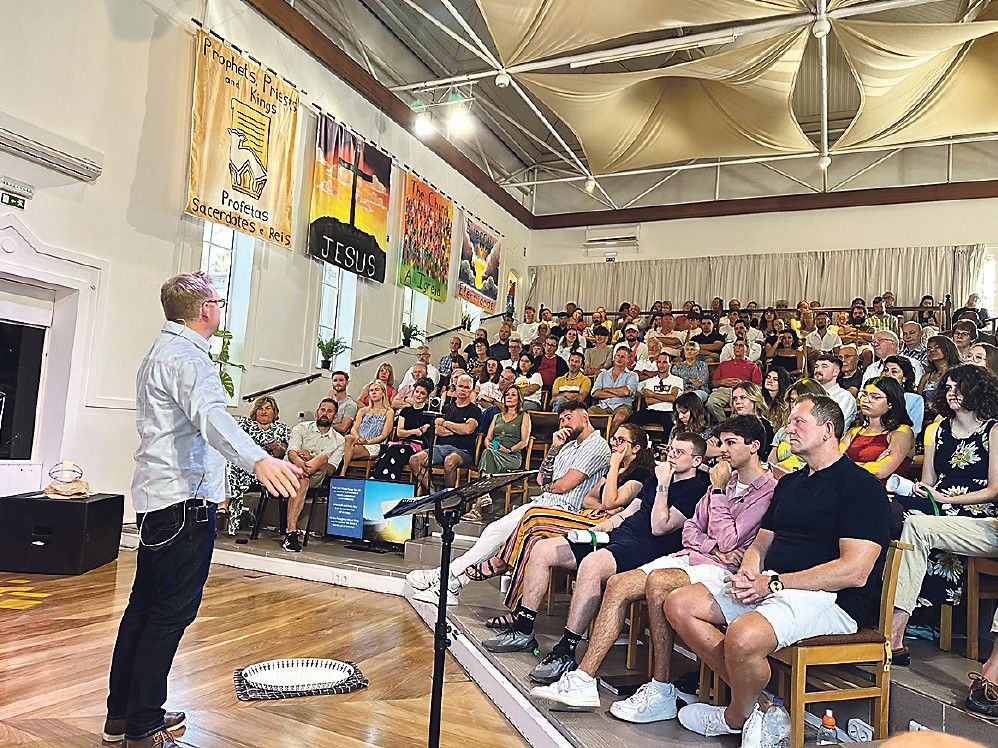
In reality, only about 10% of people today attend church regularly. This represents a dramatic shift from just a few decades ago.
So what has happened? Why have so many Europeans turned their backs on church?
Why does church no longer appeal to this generation? Is something wrong with society — or has church itself become something it was never meant to be?
My own experience of church has been varied, shaped by two very different contexts.
My first experience of church was deep in the Amazon jungle of Brazil, where my parents served as missionaries for most of my childhood. As a family, we travelled by boat along the tributaries of the Amazon River, visiting small settlements of ribeirinhos — people who live along the riverbanks.
During the day, my father would pull out hundreds of decaying teeth in order to relieve people of excruciating pain, while my mother delivered babies and offered medical help to anyone in need. Church, in that context, was very simple. All that was required for a sanctuary was a shelter made of dried palm leaves, under which people would gladly gather.
They would come out of the forest and spend hours together singing joyful songs, accompanied by my father on his piano accordion. This was always followed by a simple Bible story, told more often by my mother so engagingly that even the smallest children were completely captivated. Everything was relaxed and informal. My “Sunday best” consisted of shorts and flip-flops. Church was hot, noisy, and alive — a place where chickens and cute little puppies wandered freely among the congregation.
My second experience of church came when my parents visited Northern Ireland. I think I must have been about six years old. Sunday morning arrived, and I left the house feeling as though I was wrapped in a straitjacket, wearing a three-piece suit. I had never even seen a shirt and tie before, never mind worn one. My sister looked equally uncomfortable, dressed up like a life-sized Barbie doll.
The church
The church itself was an enormous red-brick building with stained-glass windows. As I entered, I was struck by the darkness and the musty smell of mildew. The floors were covered in deep blue carpet, and the walls were lined with dark wooden panelling from floor to ceiling. The seats were extremely uncomfortable, with backs set at a perfect ninety-degree angle.
All the men wore dark suits, and the women looked as though they had stepped straight out of a portrait of the Royal family. The children sat rigidly beside their parents, barely daring to move. Then came the music which thundered out into the building from a massive pipe organ, so loud that the bass notes vibrated through the floor and rattled right up into my ribcage. Everyone sang from a book, but the melody was sombre and depressing.
Looking back now, I know exactly which church experience I preferred. Despite the heat of the jungle, I still often long for my church on the banks of the river Amazon.
Now, in my late fifties, I still love church. In fact, I have been a pastor of one here in the Algarve for the past eighteen years, and my life literally revolves around it. Although my experience of church has at times been chequered - sometimes negative and even traumatic - I have remained committed because I have come to understand what the true church actually is.
Finding the answers
I didn’t find the answer by examining buildings, architectural styles, or religious traditions. I found it by returning to the Bible and allowing Scripture itself to define what a real church is and I’ve seen it expressed in both formal and informal settings. Ultimately, the church is not a human institution or invention. It was birthed in the heart of God.
Church is God’s way of engaging with humanity. It can happen under a palm tree or inside the most elaborate building. According to the Bible, the church does not belong to any person, denomination, or tradition. It is made up of people - imperfect people who are followers of Jesus. In fact, the church is less like a museum for saints and more like a hospital for the sick, where the Word of God (the Bible) is the medicine and Jesus is the cure.
The Bible uses many images to describe the church, and the descriptions may surprise you. When you take time to consider them, real church looks very different from what many have been led to believe. It is a body, a spiritual building, the Bride of Christ to name a few biblical analogies. But probably the one I love the most is that the church is God’s family — a community bound together by love. It is made up of people from every race, language, and nation, brought together as one.
And Scripture sums it up beautifully:
Ephesians 2:19-22
19 So now you Gentiles are no longer strangers and foreigners. You are citizens along with all of God’s holy people. You are members of God’s family. 20 Together, we are his house, built on the foundation of the apostles and the prophets. And the cornerstone is Christ Jesus himself. 21 We are carefully joined together in him, becoming a holy temple for the Lord. 22 Through him you Gentiles are also being made part of this dwelling where God lives by his Spirit. (NLT)
That is the biblical church — not a building, not a tradition, but a living body, a family, a spiritual house, alive with purpose, love, and grace. The dwelling place of God.
Whatever experience you have had in the past of church, why not give one a try? There are a growing number of churches all over Portugal and a Google search will quickly guide you. Some are more informal than others but there are many who will be a blessing to you. If you are not able to attend a church why not start reading the Bible to find our what a real one should be.
Here are some useful links that might help you:
 Add as a preferred source on Google





 Portugal Handbook
 English
 Nederlands
 Deutsch
 Français
 Español
 Italiano
 Svenska
 Pусский
 中文
中文 Türkçe
 Português
 Czech
Czech Hungarian
 Polski
 عربي
عربي Suomi
Suomi עִברִית
 Português (Brasil)
Follow us on social media