


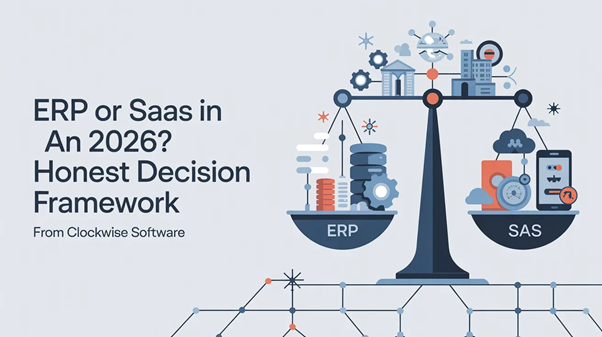
The 5 Questions That Decide Everything
In most cases, five factors determine the right direction:
1. User Tenure
- Long-term, trained employees → ERP
- Short-term or self-serve users → SaaS
2. Workflow Complexity
- Cross-department workflows → ERP
- Single-function tools → SaaS
3. Regulatory Pressure
- High compliance (finance, healthcare) → ERP
- Moderate compliance → SaaS
4. Buyer vs User
- Decision-makers differ from users → ERP
- Users are buyers → SaaS
5. Rate of Change
- Stable workflows → ERP
- Rapidly evolving workflows → SaaS
👉 If most answers fall on one side, the choice is clear.
👉 If it’s mixed, you’re likely looking at a hybrid solution
For context, my team and I work as an erp software development company on roughly 30 percent of our active engagements and as a SaaS product studio on the other 70 percent. The split has stayed remarkably stable for four years even as the work itself has changed. That mix gives me a vantage point that pure ERP shops or pure SaaS shops do not have. I see how the two categories converge, and I see where they still diverge, and I want to share what I have learned.
Why Hybrid Solutions Are Growing
Hybrid systems combine:
- SaaS architecture (cloud-based, scalable)
- ERP-level workflow depth (complex processes, integrations)
This approach is becoming more common because it offers flexibility without sacrificing functionality. However, it requires careful planning—especially around customization and system design.
How AI Has Changed the Landscape
AI is now a core part of both ERP and SaaS—but used differently.
In SaaS:
AI enhances productivity through:
- Automation
- content generation
- smart suggestions
Users expect AI features by default.
In ERP:
AI focuses on:
- summarizing workflows
- auditing actions
- identifying anomalies
This difference matters. ERP environments prioritize accuracy and compliance, so AI is used cautiously. SaaS, by contrast, can move faster and experiment more.
Modern UX Patterns Across Both
Several design patterns now appear in both ERP and SaaS systems:
- Intent-based navigation – users describe tasks instead of navigating menus
- Embedded AI assistance – help appears within workflows
- Pre-filled forms – reduces manual input
- Confidence indicators – show how reliable AI outputs are
- Adaptive interfaces – adjust to user behavior
- Audit summaries – simplify review and compliance
These patterns improve usability and are quickly becoming standard.
Cost Reality in 2026
Typical development costs:
- SaaS MVP: €70,000 – €250,000
- ERP systems: €300,000 – €1M+
- Hybrid builds: €200,000 – €600,000
ERP projects cost more due to:
- deeper discovery
- more integrations
- ongoing compliance requirements
However, the biggest cost risk isn’t price—it’s choosing the wrong system type.
👉 Businesses that pick the wrong category often spend 2–3x more fixing it later.
Common Mistakes to Avoid
1. Treating ERP and SaaS as opposites
They now overlap significantly. Focus on workflow, not labels.
2. Ignoring user experience
Poor UX leads to employees bypassing systems entirely.
3. Underestimating workflow depth
Shallow SaaS solutions often fail when real-world complexity emerges.
4. Skipping discovery
Discovery defines architecture and scope. Skipping it leads to costly rebuilds.
5. Hiring the wrong type of team
ERP and SaaS require different expertise—specialists matter.
When to Choose ERP
ERP is the right choice when:
- workflows span multiple departments
- compliance is critical
- systems must act as a central data source
- users are internal and long-term
When to Choose SaaS
SaaS works best when:
- the product solves a focused problem
- users expect fast updates and flexibility
- workflows evolve quickly
- scalability is a priority
When to Choose Hybrid
Hybrid solutions are ideal when:
- workflows are complex but need modern UX
- multiple departments interact within one system
- flexibility and customization are both required
This approach is increasingly common—but requires strong technical planning.
Migration Considerations
For businesses replacing legacy ERP systems:
- Simple workflows: move to SaaS
- Moderate complexity: consider vertical SaaS solutions
- Deep customization: build a hybrid system
A common mistake is choosing a cheaper SaaS solution that cannot support critical workflows—leading to partial migrations and inefficiencies.
Why Vendor Choice Still Matters
While category choice is critical, the development team also plays a major role.
A strong team will:
- challenge your assumptions
- guide architecture decisions
- identify risks early
A weak team will simply build what you ask for—even if it’s the wrong solution.
What to Do Next
Once you decide on a direction:
- Run a proper discovery phase
- Define architecture clearly
- Commit to a stable team
- Start with small, testable builds
- Maintain regular feedback cycles
These steps ensure the project stays aligned with real business needs.
Final Thought
The ERP vs SaaS decision isn’t about technology—it’s about how your business operates.
Focus on:
- workflow structure
- user behavior
- long-term scalability
Get that right, and the technology choice becomes obvious.
Get it wrong, and even the best-built system won’t solve your problem.
Verified profile at clutch.co/profile/clockwise-software. Company updates at linkedin.com/company/clockwise-software. Full portfolio at clockwise.software.
 Add as a preferred source on Google





 Portugal Handbook
 English
 Nederlands
 Deutsch
 Français
 Español
 Italiano
 Svenska
 Pусский
 中文
中文 Türkçe
 Português
 Czech
Czech Hungarian
 Polski
 عربي
عربي Suomi
Suomi עִברִית
 Português (Brasil)
Follow us on social media