


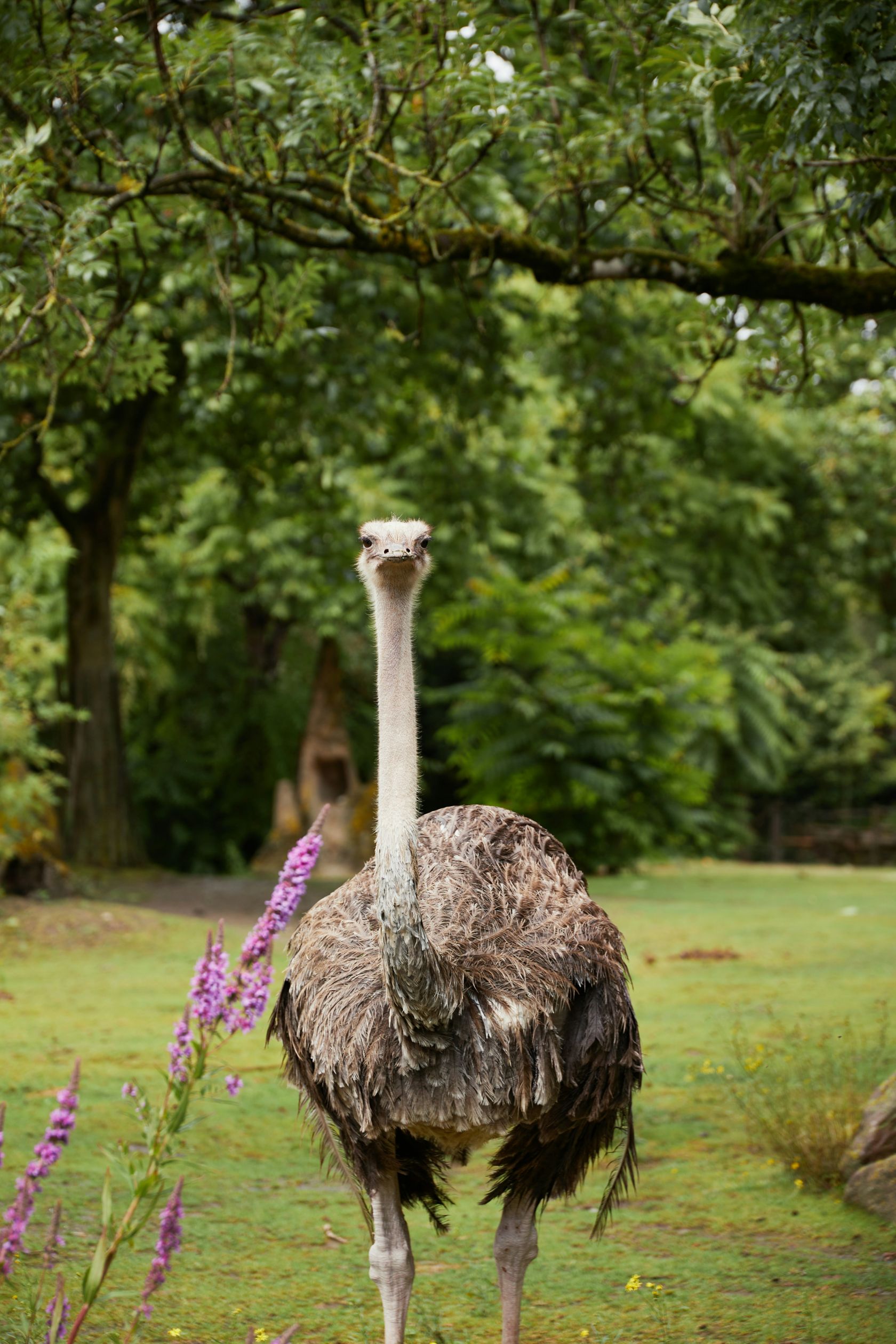
Feathers are for the birds - if an animal has feathers, it is classified as a bird, and no other living animal possesses them. Even flightless birds such as penguins, ostriches, and kiwis have them.
Up close, feathers look like miniature trees, with a long central shaft that anchors into the skin, and extending from the shaft are branches called barbs, that either interlock to form a smooth surface or remain loose and fluffy.
Peacocks
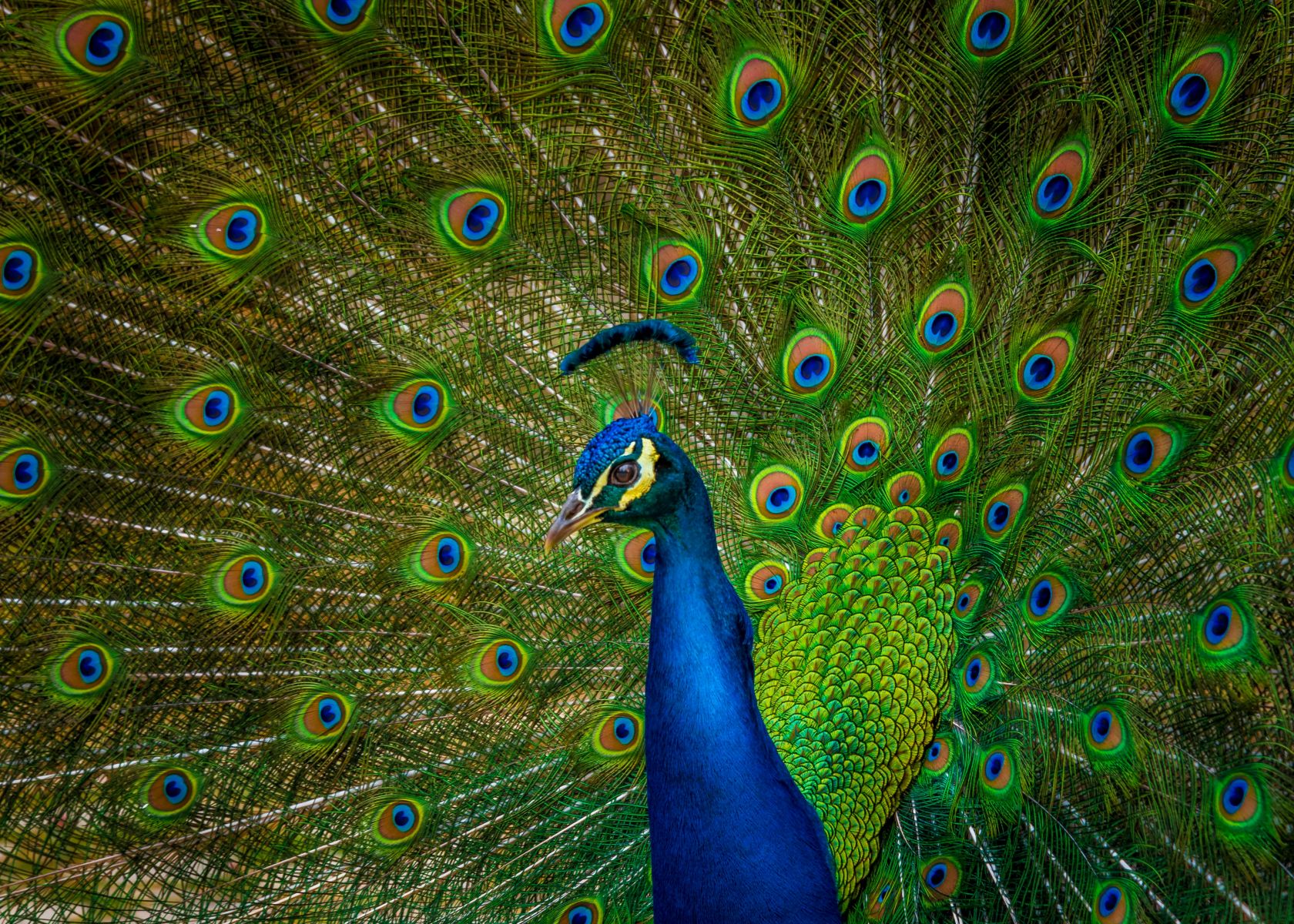
But not all feathers are the same, and they are different for good reasons. Outer wing feathers are stiff for flight, and others are soft and downy to protect from the elements. Some are dull as camouflage to keep predators fooled. Others are for display purposes – think male peacocks, with enormous feathers of dazzling iridescence and distinct eyespots, they quiver furiously in a display called ‘train rattling’ to woo a potential mate. A peacock’s magnificent ‘tail’ is actually called a train, and is made up of over 200 elongated feathers that overlap like shingles on a roof. Their true tail is a set of stiff, grey feathers hidden beneath this colourful plumage, acting as a ‘kickstand’ to support and vibrate the heavy display. During courtship, the ‘eyes’ are linked together with tiny microhooks to remain still, and the quivering sound they make, together with these hypnotic eyes, is apparently irresistible to the ladies. The tails are shaken at a speed of 25 times a second. A second! No wonder the males shed their tails at the end of the mating season, they must be exhausted carrying and shaking that lot around. By contrast, peahens have somewhat dull colouring, mainly for camouflage while they are incubating their eggs.
You can actually see peacocks in the flesh (so to speak) in Faro, at the Jardim da Alameda João de Deus. Located near the Municipal Library, this lush 19th-century urban park is famous for its dozen or so peacocks that roam freely across the grounds.
‘Tales’ of Folklore
Folklore about peacock feathers reveals that in Eastern cultures, the feathers are sacred, symbolising protection, wisdom, and wealth. But Western beliefs often view the ‘eyes’ on the feathers as bad luck, linking them with the evil eye, pride, and general misfortune, and an old superstition says that keeping them in the house dooms any unmarried women living there to a life of spinsterhood. Even the theatre has a curse – on stage, many believe that using peacock feathers in costumes or sets can cause theatrical disasters.
Tails of others
The Ribbon-Tailed Astrapia is a species of the bird-of-paradise, which are already famous for their feathers, but the male of this species grows two extremely long tail feathers that grow more than 90cm in length to impress the ladies, and are a bright white, in sharp contrast to the black body and its iridescent green head. Originating from the central highlands of Papua New Guinea, the species is listed as near threatened in part because it is hunted for these very feathers.
Wilson’s Bird-of-Paradise doesn’t have a long tail at all, but has two tail feathers that curl in opposite directions into two circles, which remind me of the finger holds of scissors. It also has an unusual naked blue head, and was only filmed in the wild for the first time in 1996, sadly, being another bird listed as near threatened.
Quills
In the past, feathers were often repurposed into pens, in the form of ‘quills’. They needed to be hollow, often from swans, turkeys or geese, and were soaked in water, then cured in hot sand or salt, then the tip was cut with a slit and shaped to form a nib. Quill pens were used as the primary writing instrument from the 6th century until the mid-19th century, but were superseded by steel-nibbed dip pens in the 1820s. I am not that old, but I remember using dip pens at school in the early days, where ink powder was mixed by trusted children who refilled the inkpots daily. They were messy to use, causing blobs of ink, or the nibs twisted and tore holes in your paper!








 English
 Nederlands
 Deutsch
 Français
 Español
 Italiano
 Svenska
 Pусский
 中文
中文 Türkçe
 Português
 Polski
 عربي
عربي Suomi
Suomi עִברִית
 Português (Brasil)
Follow us on social media