


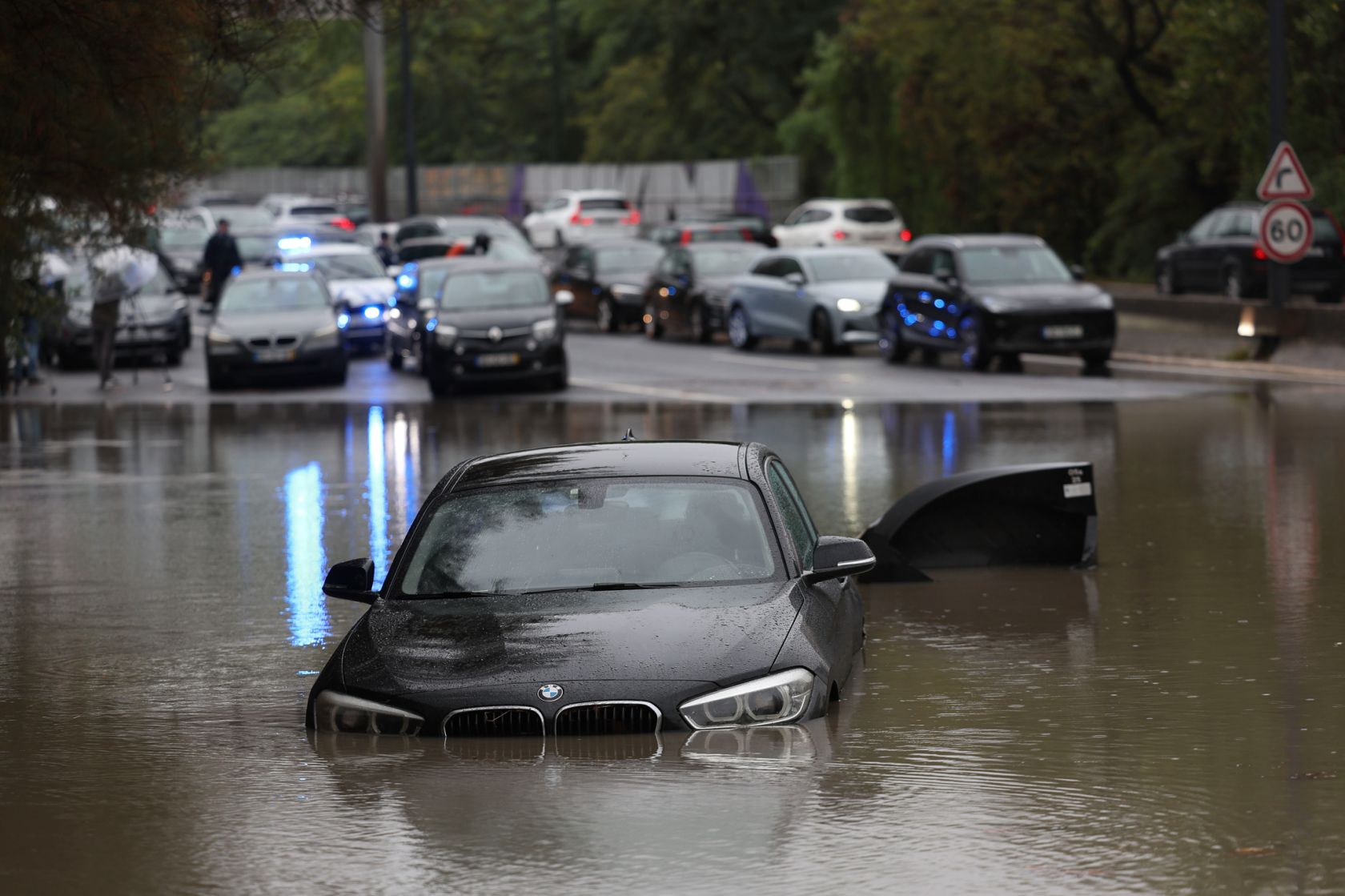
According to the same source, the incidents were “mostly flooding and one or two structural collapses, such as electrical cables, and a fallen tree”.
The incidents were not considered concerning and caused no injuries, the municipal firefighters added.
Portugal has been under a state of alert since midnight on 11 November due to the passage of the Charles depression.
The depression crossed Madeira and was making its way towards mainland Portugal at 10 am, but, according to the Portuguese Institute for the Sea and Atmosphere (IPMA), it changed its characteristics, with wind speeds and gusts decreasing. Only the district of Faro remains under a red gust warning (the most severe), while Faro and other districts across the southern and central regions remain under rainfall warnings.
Winds in the Algarve
Gusts forecast for the district of Faro could reach 120 kilometres per hour (km/h) and, in the most exposed areas, up to 140 km/h.
In the districts of Lisbon, Setúbal and Beja, gusts of 100 km/h are forecast, potentially reaching 120 km/h in the most exposed areas, such as higher mountain ranges and coastal areas.
The remaining districts in Alentejo and the Central region are under yellow gust warnings, with winds estimated at 90 km/h.
Regarding rainfall in these districts, red precipitation warnings remain in place, with only Évora downgraded to orange (the second level on a three-level scale).
Warnings to end
These warnings end at 6 pm in the south of the country, while in the north they end at 9 pm, although further adjustments may be made throughout the day.
Forecasts of worsening weather conditions prompted the Government to decide to close schools and advise people to limit travel and work remotely wherever possible.
The Charles depression caused more than 200 incidents in Madeira overnight, mainly flooding, fallen trees and landslides.
The Government decided to close schools and non-essential public services across all districts, while more than 200 flights were cancelled in Lisbon, Faro and Madeira.
During the night, Greater Lisbon and the Setúbal Peninsula were the areas most affected, particularly by flooding.
Set The Portugal News as your preferred source for news on Google
 Add as a preferred source on Google


 Portugal Handbook
 English
 Nederlands
 Deutsch
 Français
 Español
 Italiano
 Svenska
 Pусский
 中文
 Türkçe
 Português
 Czech
 Hungarian
 Polski
 عربي
 Suomi
 עִברִית
 Português (Brasil)

Creating bad AI images for articles is lazy, but also misleading. If you aren't prepare to take or pay for an actual image, at least check the quality of the image you are generating.
By adrian allen from Porto on 12 Nov 2026, 06:54