



That’s the odd thing about tournament poker. The rules of the cards never change, but the decisions around them do. A multi-table event can start with hundreds of players spread over many tables. As people bust out, tables get merged until one is left. Along the way, stack sizes, blind levels and payout spots change how everyone plays, so it’s more useful to understand those shifts than to follow one strategy from start to finish.
What Sets a Multi-Table Tournament Apart
In a cash game you can leave between hands and the blinds stay put. Tournaments don’t work that way. Everyone starts with the same number of tournament chips, the blinds rise on a schedule, and if you lose your chips you’re out, unless the event allows re-entry.
That’s what the MTT Poker format does to you: getting through one stage doesn’t make the next one easy. A stack of 20,000 looks huge when the blinds are 100/200. At 1,000/2,000 it’s ten big blinds. Same chips, far less use. That’s why experienced players talk about their stack in big blinds, not raw chips.
Early Levels Aren’t a Race
Early on, stacks are deep compared with the blinds, so you’ve got room to make decisions over several betting rounds and losing a small pot isn’t a disaster. It’s tempting to play loads of hands while the blinds are cheap. Don’t. Weak hands still cost you after the flop, and a player who enters too many pots can lose a big chunk of their stack without ever facing a tough opponent.
Use the early levels to watch. Who raises a lot? Who calls too much? Who can’t fold a pair? You’ll want that information once the blinds go up and every decision costs more.
Why Stack Size Changes Your Options
Sixty big blinds gives you flexibility. Eight doesn’t. With a deep stack you can make smaller raises, play after the flop and take the odd speculative hand. A short stack has fewer choices, and calling a raise can commit so much of what’s left that folding later is nearly impossible. Here’s the rough picture:
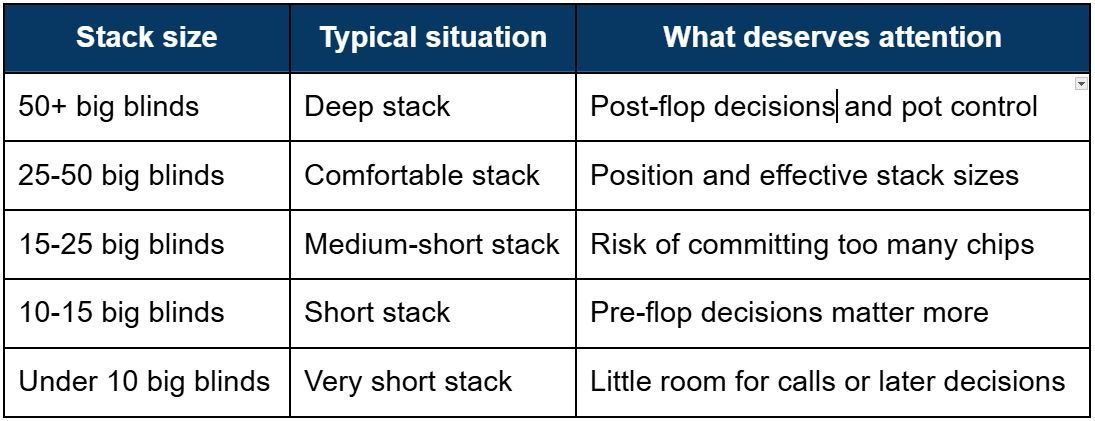
These are broad labels, not orders to make the same move every time. The effective stack matters too, which is the smaller of the stacks in a hand. With 80 big blinds you still can’t win more than 12 from someone who only has 12.
The Bubble Changes How People Play
The bubble is the stretch just before the remaining players hit the paid places. Say 100 players get a prize and 101 are left. One elimination separates everyone else from the money. Some players tighten up hard, because they’ve sat there for hours and don’t want to leave with nothing. Other players notice and start raising more, betting that the tight ones will fold.
The pressure isn’t equal. A big stack can lose a medium pot and carry on, while a player with a few big blinds can be knocked out by any serious decision. Tournament chips also don’t convert straight to cash, especially near big payout jumps, which is why tournament decisions can’t always be judged like cash-game hands.
The Hand Rankings Never Change
With all the talk of stacks and stages, it’s easy to forget the hand rankings never move. A flush beats three of a kind on the first hand and on the last. Say you hold three kings, the board has three hearts and an opponent shows two more. Their flush wins. If you need a quick refresher on the difference, you can look here for a comparison.
What changes during a tournament isn’t the ranking. It’s how much risk a hand is worth. A strong but vulnerable hand may deserve different treatment when you’re near elimination than when you’re deep-stacked.
The Final Table Is a New Challenge
At the final table the priorities shift again. Fewer opponents, high blinds, and each bust-out might push the rest up a pay step. A player who stayed patient through the middle may now have to fight harder for blinds and antes. But raising blindly gets expensive. Picture a medium stack sitting between two huge ones: those opponents can put real pressure on them. Meanwhile someone else at the table has three big blinds left.
Those relative stacks decide whether a marginal risk is worth taking. Final-table play is mostly a balance between winning more chips and losing a payout spot that’s already within reach.
Does Crypto Change Anything?
Some online poker sites accept digital assets. If you’re looking at poker crypto, you may fund your account with Bitcoin or another supported coin instead of a bank card. That changes how the money gets in, not how the tournament runs. Blind increases, eliminations and payouts follow the event’s rules however you paid.
Crypto does need extra care. There can be network fees, the exchange rate can move, and confirmed transfers are hard to reverse. Some sites also want ID before they process a withdrawal. Check the platform’s legal status where you live, the entry fees, the withdrawal rules and the tournament conditions before you send anything.
The Tournament Never Stays the Same
A multi-table event can start with deep stacks and plenty of time to think. A few hours later the same players are scrapping over blinds that eat a real slice of their chips. Then come the bubble and the final table, where payout gaps add another kind of pressure.
What works at the start won’t necessarily work at the end. Players who watch stack sizes, blind levels and how their opponents behave have more to go on as things change. The cards stay familiar. Everything around them is what makes tournament poker feel so different.
Set The Portugal News as your preferred source for news on Google
 Add as a preferred source on Google


 Portugal Handbook
 English
 Nederlands
 Deutsch
 Français
 Español
 Italiano
 Svenska
 Pусский
 中文
 Türkçe
 Português
 Czech
 Hungarian
 Polski
 عربي
 Suomi
 עִברִית
 Português (Brasil)

Follow us on social media