


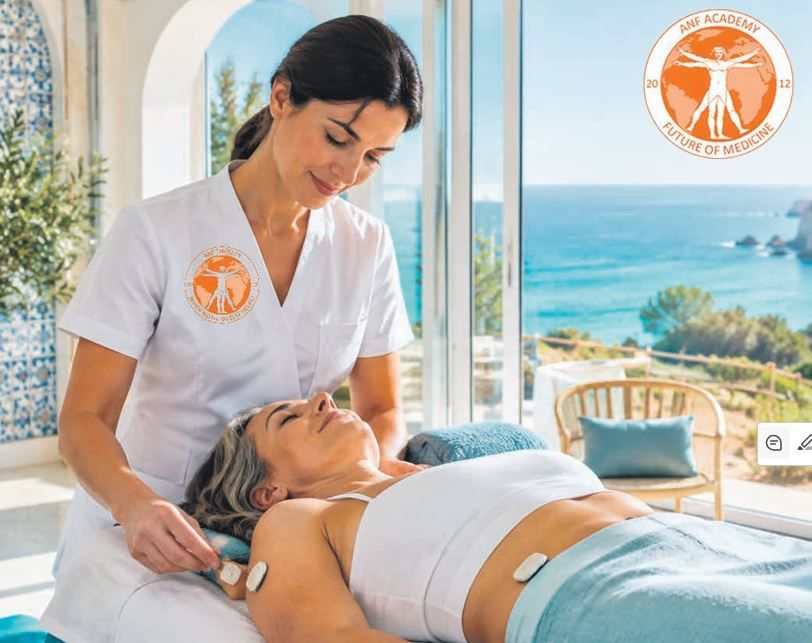
Amino Neuro Frequency Therapy (ANF Therapy®) is a non-invasive, drug-free approach developed for physical rehabilitation, neuromusculoskeletal management and supportive care. The method uses small wearable ANF Devices applied directly to the skin. According to the technology’s official description, these Class I medical devices contain specific frequency configurations intended to support the management of pain, discomfort, swelling, reduced mobility and musculoskeletal impairment when applied by trained healthcare professionals.
ANF Therapy is not intended to replace diagnosis, pharmacological treatment or conventional medical care. Rather, it may be considered a complementary intervention within an individualised clinical plan. In Portugal, the technology offers an opportunity to expand access to patient-centred care through certified partner clinics or, when clinically appropriate, through referral to the central clinic in Spain.
This model may be particularly relevant for the Algarve, an internationally connected region with a significant foreign-resident population, a growing older demographic, active tourism and increasing demand for high-quality, multilingual healthcare services.
The Technology and Clinical Method
ANF Therapy uses thin devices placed on clean, dry skin according to a protocol selected by a trained practitioner. The devices do not release medication or chemical substances. According to the official ANF model, they are wearable tools configured with specific frequency codes selected according to the practitioner’s assessment and the patient’s clinical presentation.
The method may be integrated with physiotherapy, therapeutic exercise, manual therapy and other established rehabilitation procedures, provided that the practitioner operates within the relevant professional and regulatory scope. A typical session involves three stages: clinical assessment, application of selected devices and reassessment.
In the published observational study, practitioners assessed patients before treatment, applied the devices, monitored their responses and reassessed outcomes between 10 and 60 minutes later. The protocol was personalised rather than based on a single standardised configuration. This approach is relevant from a medical-governance perspective because it requires patient selection, informed consent, clinical documentation and appropriate referral when red flags or complex comorbidities are identified.
Current Evidence and Limitations
The principal peer-reviewed study currently available was a real-world, multisite observational investigation involving 1,054 patients treated by 113 physical therapists in 45 countries. Participants reported a reduction in average pain intensity from 7.6 before treatment to 3.1 afterwards, with a large calculated effect size. The study also reported improvements in swelling and range of motion among patients for whom these were relevant treatment objectives. Patient satisfaction averaged 93 out of 100, while clinician satisfaction averaged 92 out of 100.
These findings are clinically interesting because the participants presented with low-back pain, knee pain, neck pain, shoulder pain and other musculoskeletal complaints. However, the results must be interpreted cautiously. The investigation was observational and single-arm, and was based largely on pre-treatment and post-treatment assessments from an initial session. It did not include a randomised control group or sham intervention. Consequently, it cannot conclusively establish that the observed effects were caused exclusively by ANF Therapy.
The authors reported mild, generally short-term reactions in 42.3% of patients. The most common were dry mouth, headache and fatigue. No severe adverse events were reported, but professional supervision remains essential, particularly for patients taking medication, living with complex medical conditions or requiring an alternative diagnosis. The researchers recommended randomised controlled trials, longitudinal follow-up and more standardised measurement of range of motion and other outcomes.
Responsible communication should therefore present ANF Therapy as a promising complementary approach with preliminary clinical evidence, rather than as a universally validated cure or replacement for established medical treatment.

Access for Portuguese Patients
Portuguese patients may access ANF Therapy through two complementary channels. The first is treatment in an associated clinic where professionals have completed the official ANF training programme and operate within their licensed scope of practice. The official clinic locator allows patients to search by city, country or postcode and identify certified professionals. The organisation states that the method is practised internationally through more than 1,600 clinics in over 63 countries, although local availability should be verified before referral.
The second option is a clinical visit to the central clinic in Spain. This may be suitable for patients seeking an assessment by a specialised team, professionals requiring advanced protocol review or cases in which a Portuguese partner clinic is not yet available.
A cross-border pathway should include clear communication regarding medical records, language, treatment objectives, follow-up arrangements, travel requirements and continuity of care after the patient returns to Portugal. From a business-development perspective, a hub-and-network model would be particularly effective. The Spanish central clinic could act as a reference centre for training, quality assurance, clinical supervision and complex-case coordination, while certified Portuguese clinics would provide accessible treatment and local follow-up.
Why the Algarve Deserves Priority
The Algarve merits preferential access because it offers a favourable environment for a One Health-oriented healthcare strategy. One Health recognises the interdependence of human health, environmental conditions, mobility, lifestyle and community systems.
The region combines a large international population, seasonal demographic variation, an active older community, sports and wellness tourism, hospitality infrastructure and strong connections with Spain. A regional ANF network could serve residents with chronic musculoskeletal pain, international retirees, athletes, rehabilitation patients, hospitality workers exposed to repetitive physical demands and visitors requiring short-term supportive care.
Clinics operating in Portuguese, English and Spanish would be well positioned to address the region’s linguistic and cultural diversity. Implementation could begin with a certified flagship partner clinic, followed by collaborations with physiotherapy practices, private medical centres, sports-rehabilitation providers and wellness-oriented healthcare facilities.
Success should be measured using transparent indicators, including patient-reported pain, functional mobility, treatment adherence, adverse events, referral rates, patient satisfaction and continuity of care.
Conclusion
ANF Therapy represents an emerging technology with a potentially valuable role in integrated musculoskeletal care. Preliminary observational evidence indicates improvements in pain, swelling, range of motion and patient satisfaction, while also demonstrating the need for higher-quality clinical research.
Its development in Portugal should combine clinical ambition with scientific discipline, regulatory awareness and responsible patient communication. The most sustainable model is a certified network connected to the central Spanish clinic. Within this framework, the Algarve is well positioned to become a priority region for access, training and international healthcare development.
A carefully governed Algarve programme could unite medical innovation, cross-border cooperation and One Health principles, while maintaining the essential requirement that ANF Therapy complements—not replaces—professional diagnosis and evidence-based medical care.
For further information, contact CelerImpulso at +351 923 350 340 or visit www.celer-impulso.com www.anftherapy.com
 Add as a preferred source on Google





 Portugal Handbook
 English
 Nederlands
 Deutsch
 Français
 Español
 Italiano
 Svenska
 Pусский
 中文
中文 Türkçe
 Português
 Czech
Czech Hungarian
 Polski
 عربي
عربي Suomi
Suomi עִברִית
 Português (Brasil)
Follow us on social media