


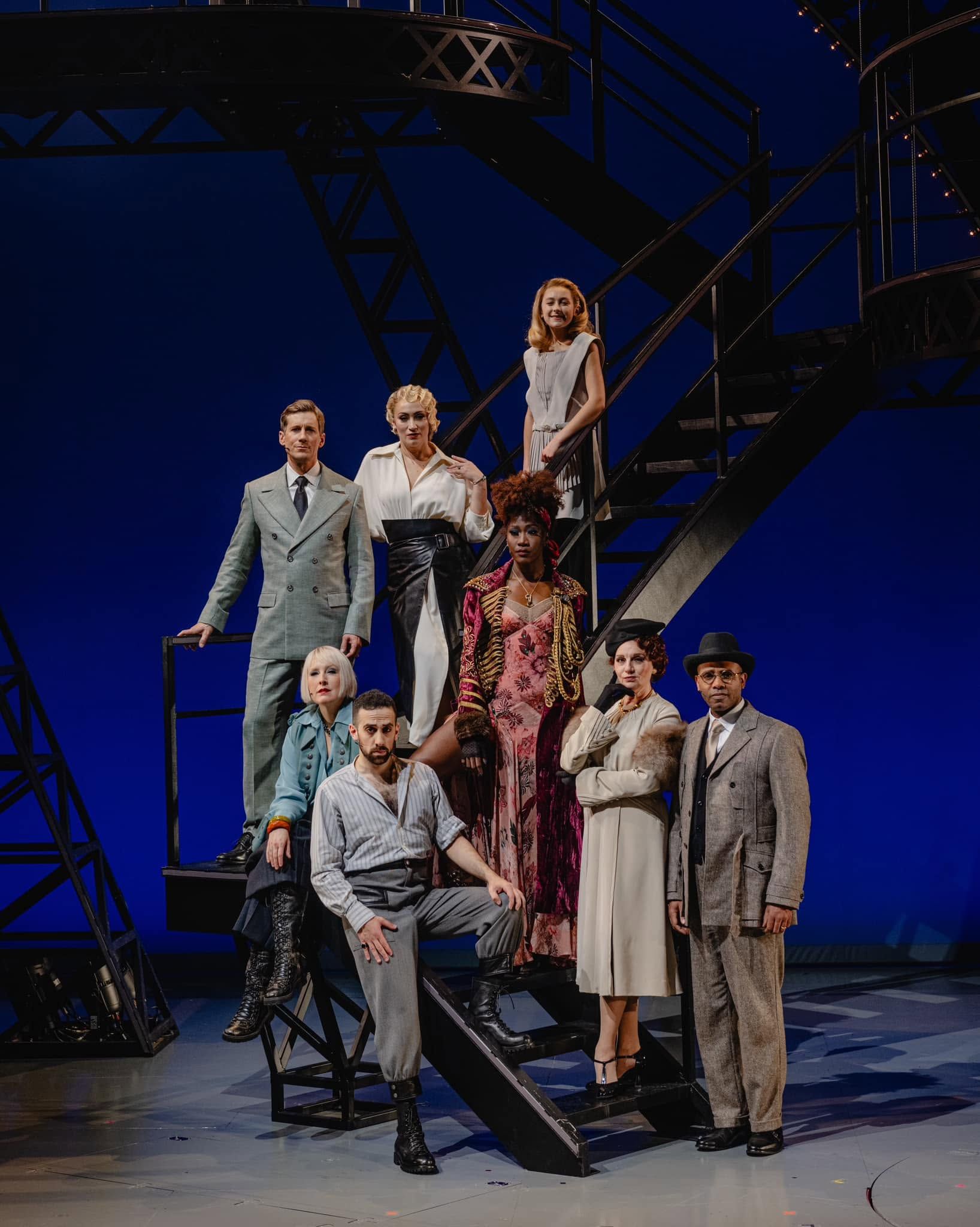
However, having said that, I’ve always been drawn to tales of real-life struggles, as opposed to fiction. Once, quite by accident, I went to see a musical about the true-life struggles of a Polish painter called Tamara Lempicka, who just so happened to be the wife of a nobleman.
The story tells of how the couple fled the Russian Revolution and ended up in the heart of Paris during the heady days of the 1920s. With her husband struggling to adjust to losing the status, privilege and wealth that his noble upbringing had afforded him, the whole exiled family are forced to eke out a humble existence, living in abject poverty until Tamara is finally discovered (as an artist). She gradually establishes herself until she eventually finds success in the rapidly changing world of the 1920s.
Living for the moment
Convinced that the terrible horrors of the First World War could never be repeated, Parisians clearly tried to cope with the still-weeping scars of history, and all the myriad traumas that had rained upon them. Many simply lived for the moment.
For those who could afford it, Parisian living became a life of debauchery that played out within the dizzying, hedonistic Maelstrom of the 1920s.
Eventually, the exiled artist actually thrives and is able to embrace some of the excesses of Parisian living. She somehow manages to maintain her marriage despite falling in love with a female prostitute, who introduces her to the dubiously dark world of opioids.
Celebrated as a female artist who finally gives voice to “girl-power” through her work, Tamara eventually secures both the popular acclaim and the wealth required to sustain this lifestyle.
In the musical, this entire period (the roaring 20s) is portrayed as a time in which the dull and melancholic ways of the past are quite deliberately abandoned in favour of exploring variety. “Diversity”, as we might be tempted to refer to it nowadays. In a scene that sums up the essence of those times, the proprietor of a lavish transgender and lesbian bar frequented by Tamara promotes it with the eternal slogan “Fraternité, Egalité, LESBIANITÉ!” (Fraternity, Equality, LESBIANITY!).
Of course, much of European society remained extremely sceptical towards such brash modernistic ideals. But Parisian socialites didn’t merely accept such “minority” sexual practices, as they actually embraced them. It was all perceived as a refreshing antidote to a very stale old order which had prevailed before the turn of the decade.
A society which had long favoured the practice of guarding “unity” in the name of social cohesion: to the detriment of the kind of individual liberties largely enjoyed in today’s world.
Political discourse
When we take into account the nature of contemporary political discourse, it’s difficult to ignore the niggles that so frequently emerge between modern-day conservatism and liberalism.
It’s become clear that the stiff ways of old still exist in the shadows, because the primary concern of even the most modern conservatives remains the preservation of order, quite regardless of individual liberties.
But the old pre-20s rigid attitude towards liberalism can almost be forgiven, because psychologists have long since mooted the idea that societies which have experienced traumas, such as war or disease, tend to veer towards small “c” conservatism; complete with that inherent need for order to arise like the proverbial Phoenix from the smouldering embers of abject chaos.
As the story of Tamara Lempicka unfolds towards the horror days leading up to WW2, fascists and communists alike squabble and indeed battle, tooth & claw, over the very future of Europe, replacing the joys of 1920s chaos with the enforcement of the archaic old-school order.
Instead of celebrating variety and diversity, both the fascists as well as the communists detested and punished it. Instead of embracing differences, they suppressed them. Instead of acknowledging the strong independent woman, they produced deeply masculine art, culture and architecture that was expressly fashioned to put women back in their “rightful place” as wives, mothers and the absolute bedrock of family life.
Once again, there was no tolerance towards individual differences, with the fervent belief that nations could only function properly if individuals submitted themselves wholly to the greater good of society. Descent must, at all costs, be eliminated.
People on the left often denigrate their right-wing opposites by citing them as being rigid, outdated, small “c” conservatives. Conservatives (small “c”) on the other hand, may see like-minded people as a group who simply sing from a common hymn sheet. Sometimes they’re dismayed when they realise that not all their fellow conservatives would even pick up that hymn sheet, let alone wholeheartedly sing from it.
So, you see, I do NOT regard myself as being conservative. Because, first of all, I’m not afraid of a little chaos, because I rather believe that a bit of chaos is actually a pretty good thing. It keeps us on our toes. I’ve never been averse to the odd dollop of good, old-fashioned “offensive” humour either. I don’t pander to lefty “WOKERY”. I absolutely detest having my wrist slapped by some tiresome old prude, simply for telling the odd risque joke: like shouting, “tits like coconuts… … and they also like a bit of birdseed or a little bacon rind during the harshest winter months”.
That’s my favourite party-stopper! Although I’ve never taken any, I actually favour decriminalising cannabis and some other types of recreational drugs. On this, Zack Polanski is the man. After all, it’s been a complete waste of time asking the police to deal with drugs, because it’s all just too rife these days. For all the Police’s best endeavours to control the drug scene, offenders barely get a slap on the wrist if they’re ever actually caught.
Western culture
As a father of three, I’m certainly not threatened by the existence of sexual minorities either.
Furthermore, I have absolutely no respect for authority that hasn’t been earned or deserved.
Every hierarchy ought to be explicitly based on competence. Meritocracy gets my vote because it always trumps the mediocrity that’s born of tokenism. Race, creed, class, sexuality, gender or political leanings should be utterly immaterial. You can either do the job, or you can’t. The best person should always reign supreme. In my book, it is really that simple.
Clearly, I can’t say that I crave order above all else because, as I’ve said earlier, a little chaos makes life a lot more interesting. However, what I do fear is a creeping lack of order and an excessive amount of chaos. A society that fails to strike a balance between pragmatism and empathy will surely crumble?
In recent times, Western culture has increasingly forged the notion that one school of thought is good and that the other is somehow evil. Which set of beliefs we personally favour is actually quite irrelevant, because if we don’t all pull together, things might swiftly get to be rather ugly. One thing I can pretty well guarantee, with a hefty degree of certainty, is that if that day does actually transpire, we could, all of us, in absolute unison, live to realise the great folly of our cantankerous modern-day politics.
Set The Portugal News as your preferred source for news on Google
 Add as a preferred source on Google


 Portugal Handbook
 English
 Nederlands
 Deutsch
 Français
 Español
 Italiano
 Svenska
 Pусский
 中文
 Türkçe
 Português
 Czech
 Hungarian
 Polski
 عربي
 Suomi
 עִברִית
 Português (Brasil)

Follow us on social media