


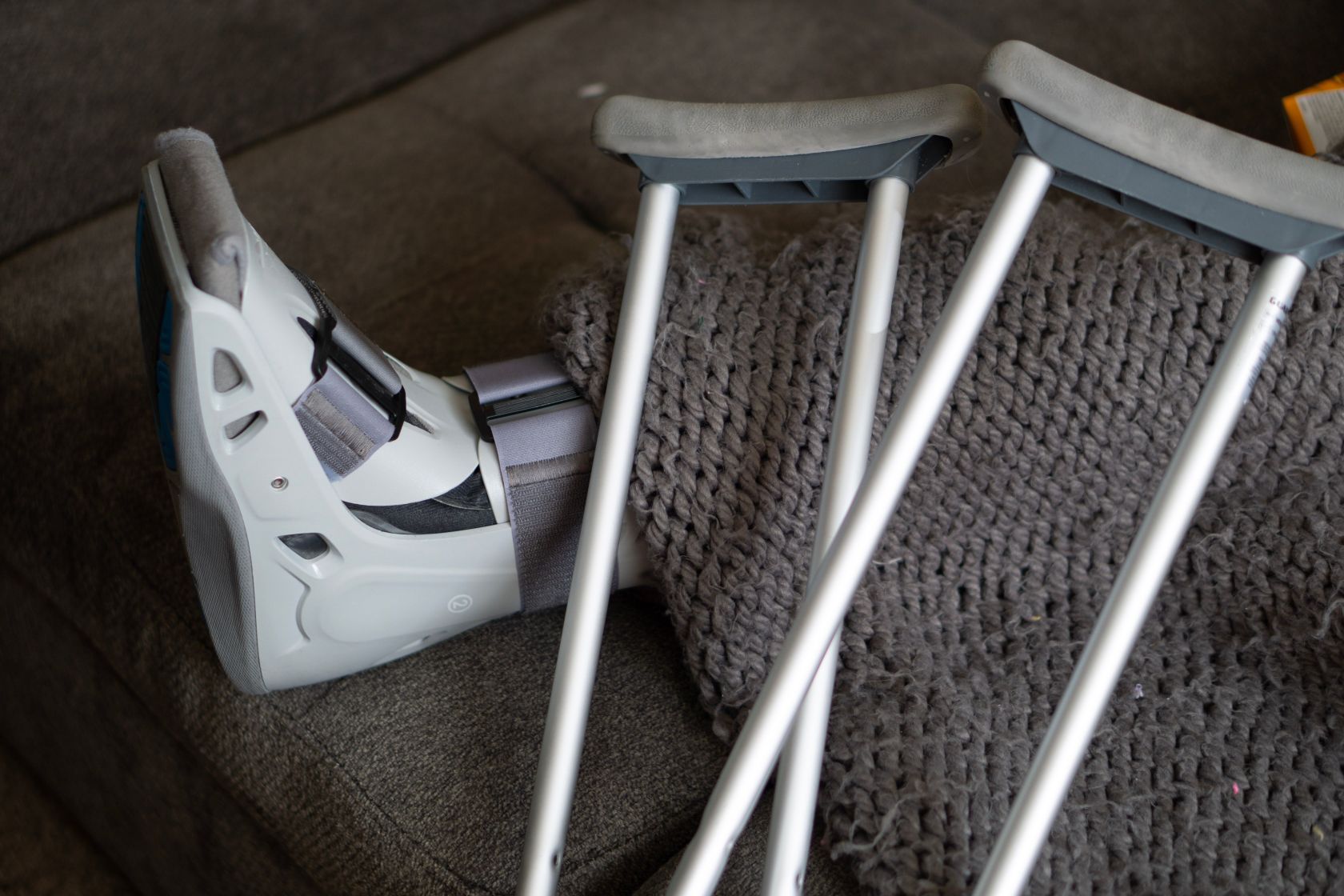
This is something I discovered for myself quite recently, after falling off my son's rather rapid (and expensive) new KTM 500 motorbike. The thing is, I was only doing 20mph over a speed-hump, but let's face it, Humpty Dumpty fell off a wall that presumably wasn't moving at all, and just look what happened to that poor old bugger. Miraculously, the motorbike was virtually unscathed, but my poor old pelvis was broken in three separate places, as well as my left hip. Just to make things interesting, I had some internal bleeding too. So, I'd done a pretty good job of it. No half measures here.
Funnily enough, it wasn't the injury itself that ground me down. That bit was fairly straightforward. I'd survived! Sure, I felt dreadful, people fussed, and I received cards from relatives that I hadn't heard from since the advent of colour television. Inevitably, somebody eventually came along and told me that turmeric, fermented yak's milk or standing barefoot in the garden at sunrise would solve everything. Funnily enough, I never found out because, apparently, bullshit isn't prescribed by the NHS.
Nope, the truly maddening bit came afterwards. Recovery itself. It's the only “journey” where everyone tells you to "take one day at a time" while secretly expecting you to be tap-dancing by next Thursday.
Day by day
The biggest problem is that we all imagine recovery as charging an electric car. We start at ten per cent, plug ourselves into modern medicine and then… bing!… we’re back to one hundred per cent by teatime.
Unfortunately, the human body never got that particular brief. At least my knackered old carcass didn't. For me, recovery resembled British Rail in the 1970s. Things lurch forward unexpectedly, stop for no apparent reason, reverse slightly, announce delays due to circumstances beyond anyone's control, but eventually get us there long after we've forgotten where we were going in the first place.
Then, there are the Consultants. Now, before anyone gets narky and reaches for the complaints form, I do realise that Consultants are astonishingly clever people. I know that these people have spent years acquiring knowledge that the rest of us simply don't possess. However, the trouble isn't what they actually say to us, it's what we choose to hear. It's all about interpretation. A Consultant might remark, "Most patients improve considerably within six months." Excellent, you might be tempted to think? Christmas is saved, I'll be climbing mountains, redecorating the spare bedroom and perhaps even taking up competitive ballroom dancing in no time flat. But, six months later, I could just about manage to put on my own socks without making noises normally associated with moving wardrobes or having wild sex. But, I'm afraid that's progress in the real world, not the Hollywood version, bearing in mind that I'm no spring chicken.
Doctors also have an infuriating habit of speaking fluent “Medical”. A phrase like "You're progressing as expected" sounds encouraging until I realised that "as expected" apparently includes feeling as though I'd been hit by bus number 13. Then come the mixed messages. One person says, "Keep moving." Another says, "Don't overdo it." Someone else says, "Listen to your body." My body, at that point, was nothing more than an unreliable witness. One leg was saying “go for a walk” whilst the other was considering legal action.
Let's face it, neither conclusion was as inviting as her next door. Therefore, the real trick, I discovered, was to stop asking Doctor Google absolutely anything. That’s because Doctor Google has googly eyes, is a known sadist, schizophrenic and an accomplished psychopath.
Not a race
Truth is, recovery is sneaky. It hides improvements in plain sight. One day, you realise you've climbed the stairs without even thinking about it. Another day, you've carried in endless bags of shopping without needing to lie down immediately afterwards. Eventually, you might even notice that you've gone several hours without discussing your latest ailments with anyone who's actually willing (or indeed unwilling) to listen. These, in and of themselves, are all minor triumphs, each one worth celebrating.
The fact is, I learnt to stop treating recovery as a race. You see, there are no medals. Nobody appeared at my front door with a brass band because my latest blood tests had improved or I’d managed to walk another hundred metres. The only person I was really competing with was yesterday's version of myself. So, I just had to be a “patient” patient. I had to trust my many Doctors (and just as many Consultants) and not treat every sentence they uttered as though it had been carved into stone tablets. Modern medicine is wonderfully clever, but it's not clairvoyance. I had to accept the bad days because they arrived whether I’d invited them or not. I celebrated tiny wins because they add up to become bigger ones.
Most importantly, I learnt this. Recovery isn't anything like Netflix.
I wasn't able to skip to the final episode. I had to binge-watch the whole sorry saga, which sagged on far longer than I’d ever anticipated. I simply had to sit through the whole damned series, including all the slow bits in the middle, where it feels as though absolutely nothing is happening. Oddly enough, hindsight denotes that those are often key episodes where all the important details are being fleshed out.
So, if you're ever in a similar position to the one I found myself in a couple of years ago. Hang in there. There are always brighter days ahead. I eventually made a full recovery. And, boy, am I grateful.








 Portugal Handbook
 English
 Nederlands
 Deutsch
 Français
 Español
 Italiano
 Svenska
 Pусский
 中文
中文 Türkçe
 Português
 Czech
Czech Hungarian
 Polski
 عربي
عربي Suomi
Suomi עִברִית
 Português (Brasil)
Follow us on social media