


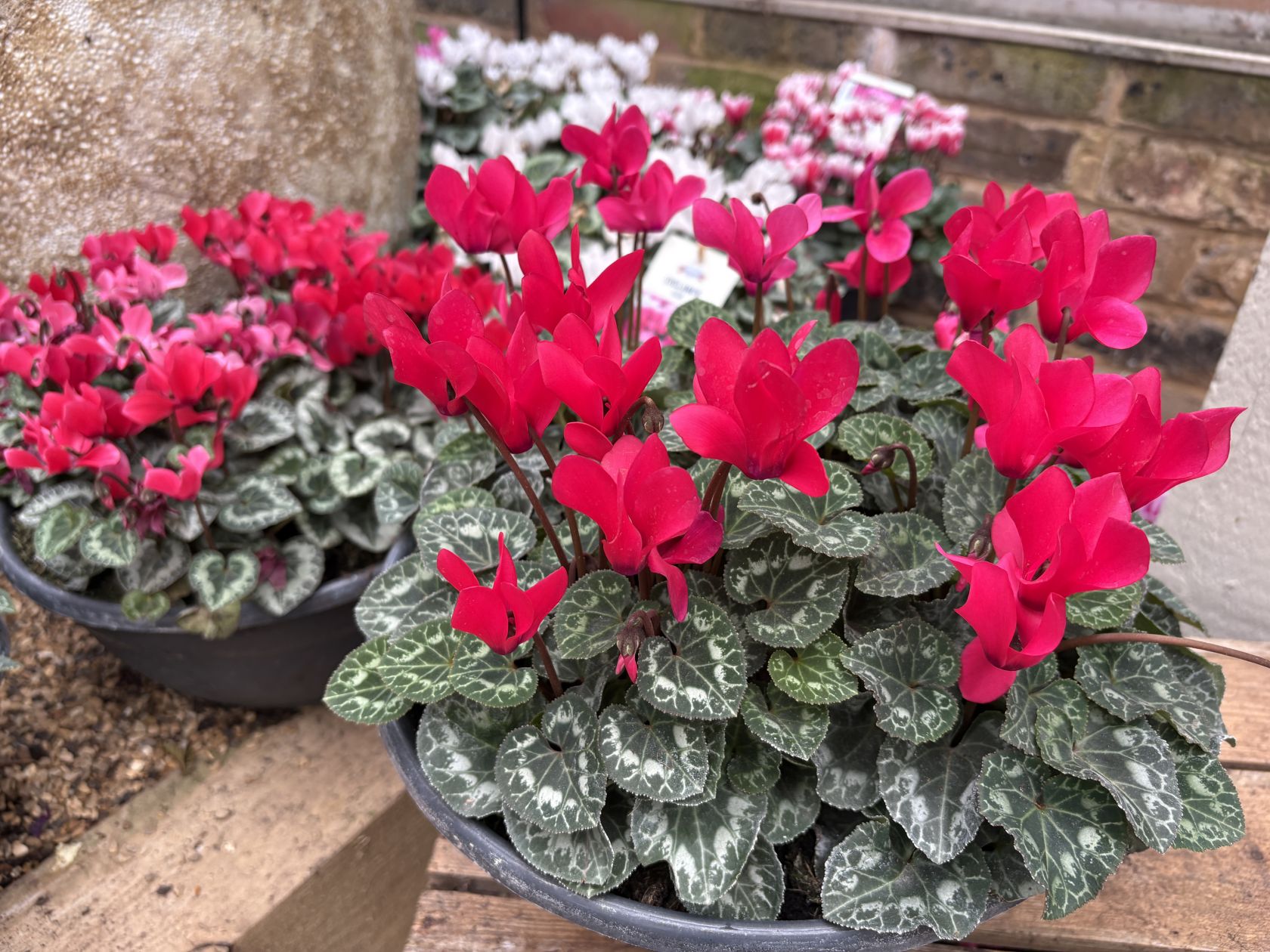
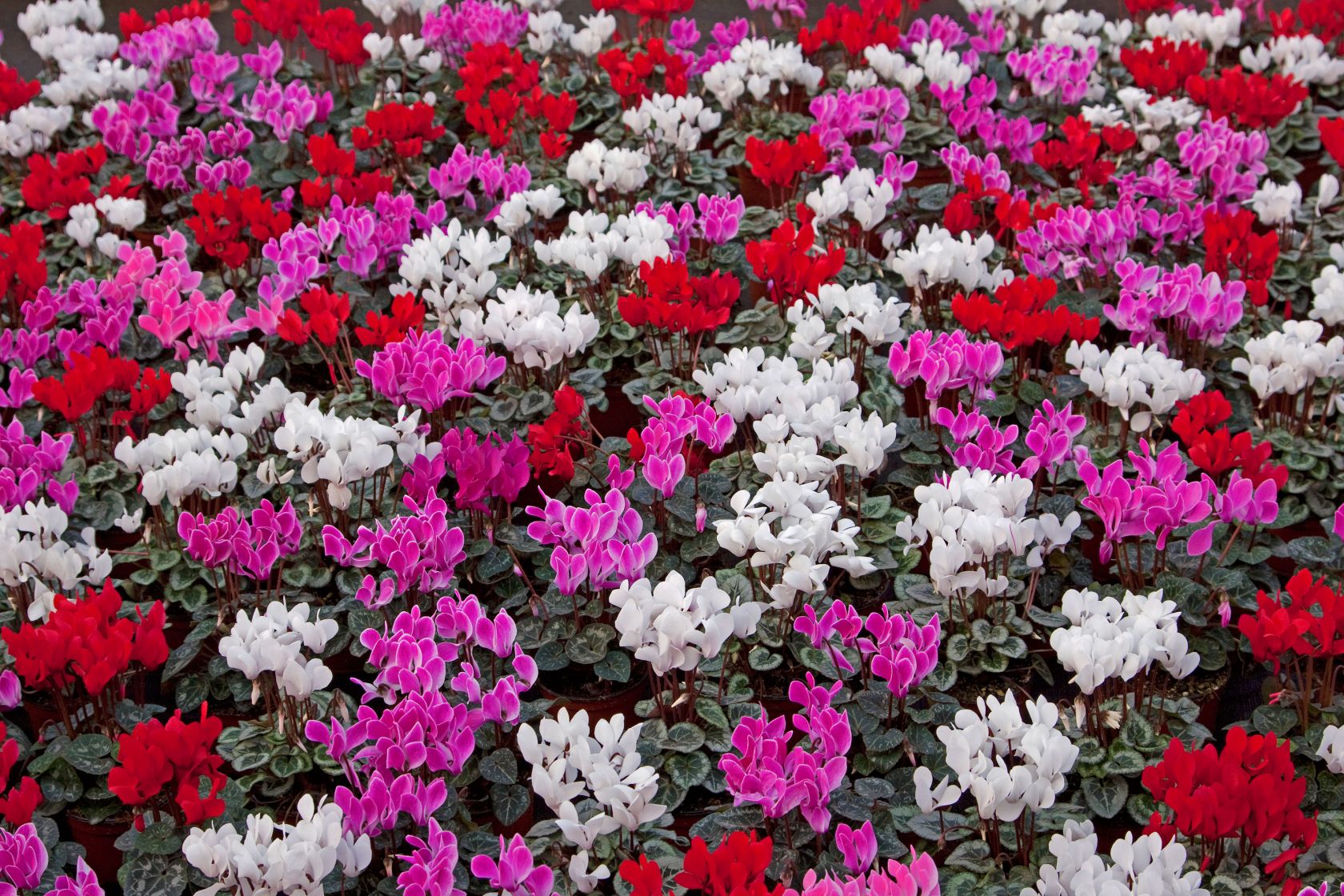
Heading into autumn, many gardeners will be picking up pots of brightly coloured cyclamen in shades ranging from deep red through pink and white, to add to their containers.
They are tuberous and can survive the heat of summer, many flowering with the onset of autumn rain, their blooms appearing before the delicate-looking foliage.
Yet some will last much longer than others which are bred to last just through the autumn before succumbing to frost, while others may go through winter and can be planted in the garden afterwards, so you need to know what you’re buying.
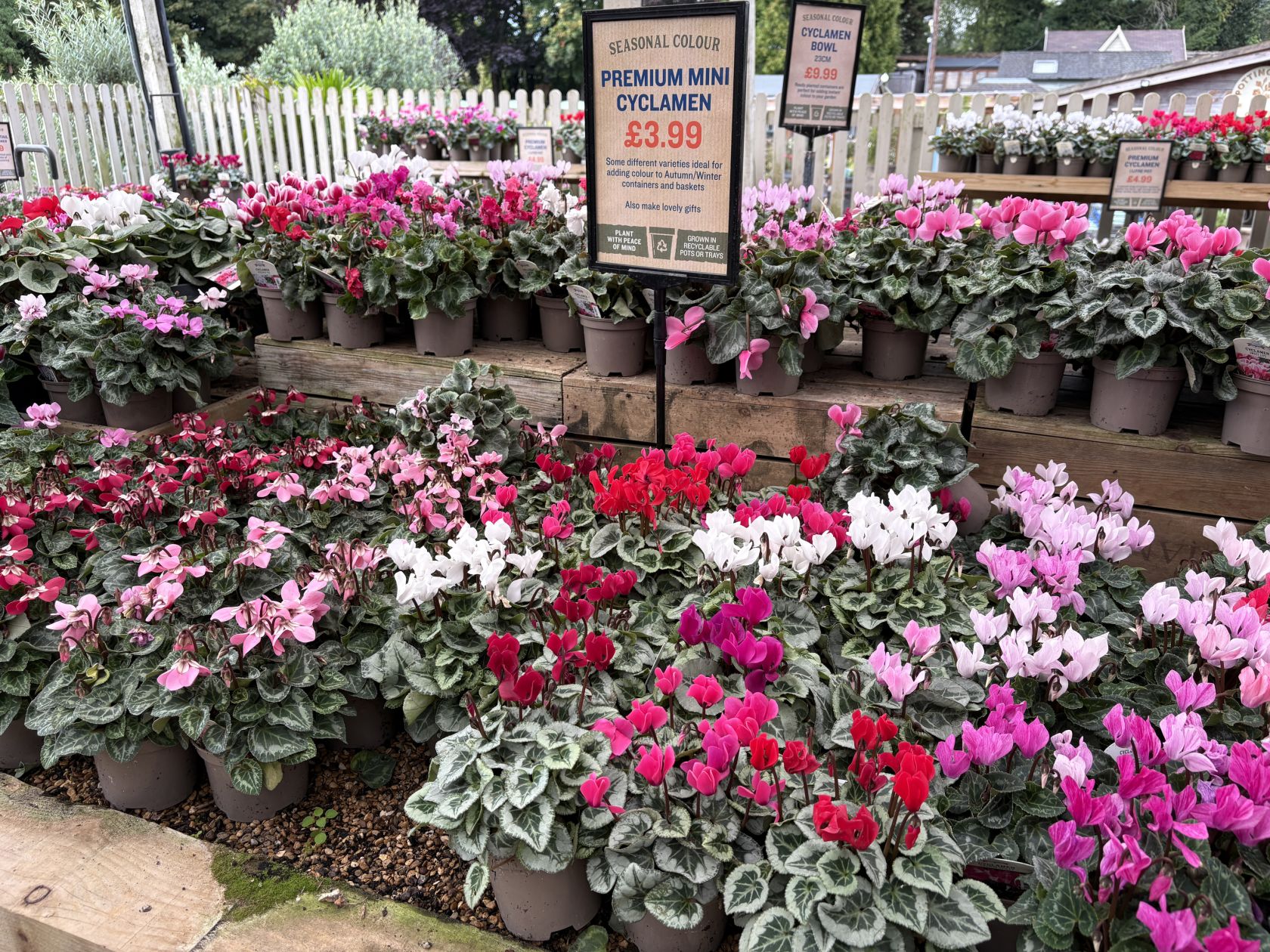
Mini cyclamen
Mini cyclamen are smaller relatives of the larger florist’s cyclamen and sold as outdoor bedding plants in autumn. They look terrific in autumn pots and are also grown as houseplants.
If you put them in an autumn pot, they should flower for about six weeks but are unlikely to survive the winter outdoors in the UK, so are generally considered bedding plants.
“Mini cyclamen, where you get the bright dual colours, are not a true perennial, but quite often they will go through. They’ll stop flowering usually in January or February,” says Kate Haines, plant manager at Squires Garden Centres.
“After that they’re not very exciting. So, if you’ve got a shady bit of garden, you can always plant them there, but there is now a hybrid cross between the mini cyclamen and the larger florist’s cyclamen.”
If you include them in an autumn pot, be aware that they will be quick to rot if they are too wet and are susceptible to grey mould. They are unlikely to make it through the winter unless it’s very mild and you put them in a sheltered spot in dappled shade and protect them from winter wet.
Available in white, pink, red and purple, these tender plants are often displayed inside, in the shade of a cool greenhouse or on a windowsill with no direct sunlight.
Florist’s cyclamen
These are larger cultivars of the wild Cyclamen persicum and they make bright and bold houseplants, often given as gifts. Many people use them as Christmas houseplants, but they need to be kept in a cool room out of direct sunlight.
They don’t like draughts, hot, dry air and don’t want overwatering. If you have a window box in a shady, sheltered spot, that might be the ideal situation.
If you want to keep your cyclamen as a houseplant for another year, plant in a loam-based compost with added horticultural grit. Good drainage is the key and if you are replanting it, make sure the corm rests just above the surface of the soil.
Don’t overfeed it as this will produce more leaves than flowers and make sure you water it at the base – not on the leaves – only when the compost starts to feel dry. Stop watering it completely in spring, put it somewhere cool for the summer, perhaps in the shade outdoors. It should show signs of life in September.
Cyclamen hederifolium
These smaller hardy types, with fine 10cm stems carrying the delicate buds which open to delicate twisted petals, are ideal for a shady spot in the garden, where they can spread to cover a wide area, each plant covering around 30cm of ground. They are available in shades of pink, white, cerise and magenta, with marbled ivy-like leaves.
They generally flower from late summer through autumn and thrive in dry shade, so can even be situated under deciduous trees, with a mulch of fallen leaves, but they won’t survive waterlogged ground. After flowering, the foliage provides useful ground cover in winter and spring. Leave them undisturbed and they should multiply, giving you pretty blooms every year.
If you’re planting them in a pot, you must have really good drainage, adding grit to the potting mix, as the tubers will quickly rot in waterlogged soil. And the pot needs to be in dappled shade, as they are naturally woodland plants.
In the ground, these cyclamen will self-seed freely, forming eye-catching mats if they are protected from summer rain.
Cyclamen coum
These small pink cyclamen produce their rounded leaves in autumn, followed by more rounded flowers through winter and early spring, and enjoy some moisture in the soil all through the year.
They are ideally naturalised under trees or in shady borders with snowdrops and primroses for a dazzling early spring picture and prefer woodland conditions of partial shade and humus-rich soil.
Plant them in autumn, winter, if the ground is not frozen, and early spring.
 Add as a preferred source on Google





 Portugal Handbook
 English
 Nederlands
 Deutsch
 Français
 Español
 Italiano
 Svenska
 Pусский
 中文
中文 Türkçe
 Português
 Czech
Czech Hungarian
 Polski
 عربي
عربي Suomi
Suomi עִברִית
 Português (Brasil)
Follow us on social media