


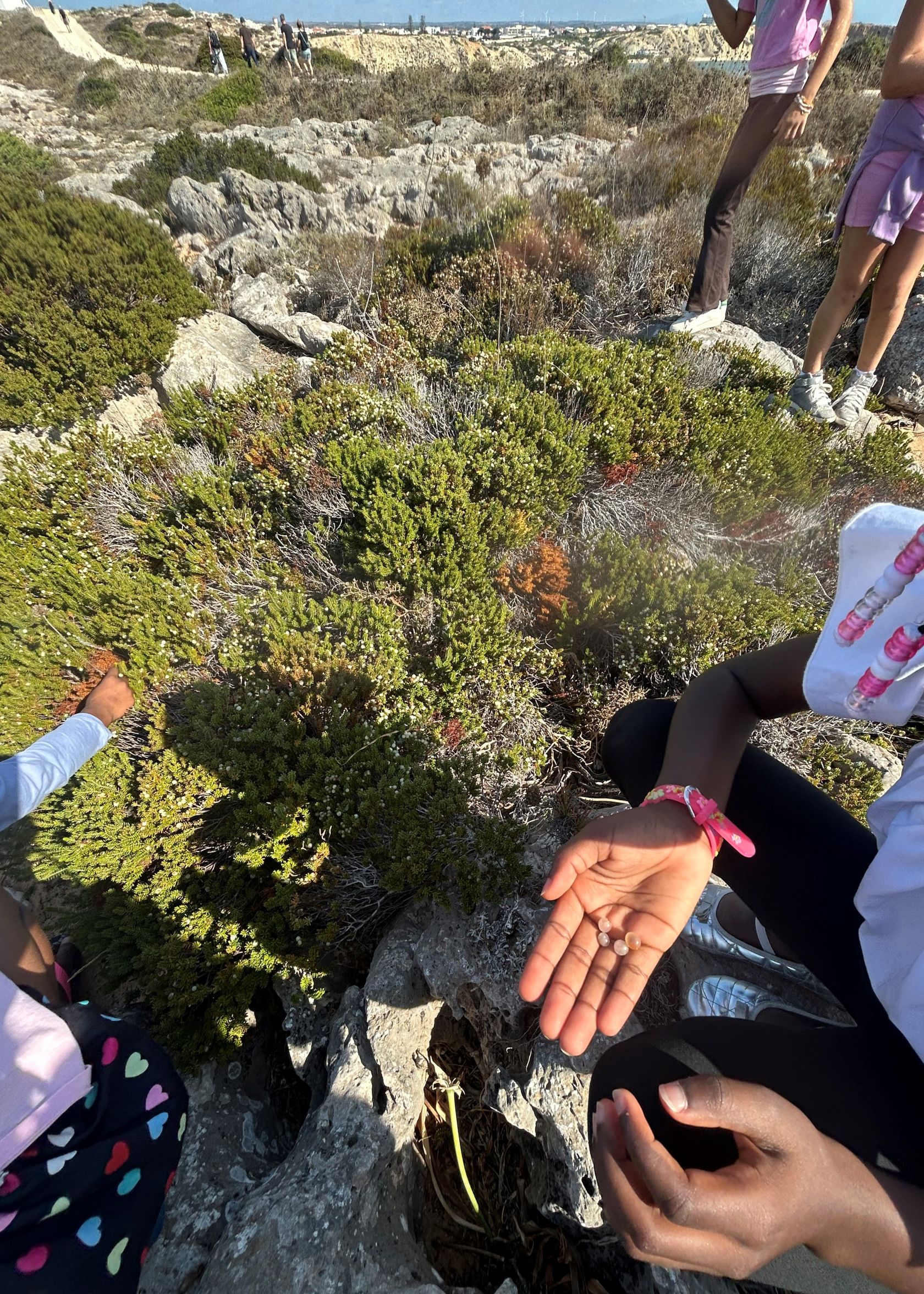
Teachers from Sagres Primary School joined the visit and explored the Sagres Fortress area with their students in the morning. The students, aged 6 to 8 years old, observed both the Sagres Fortress natural landscape with the Educational Fortress Team and the white crowberry plant with the Coordinator of the Emc2 Project. Students learned several details about the local flora, and for many of them, it was the first time they had seen male and female plants of the white crowberry species, Corema album (L.) D. Don, an Iberian endemic species, as it only occurs in Portugal and Spain. They also learned that this species' female plants bear small, edible white fruits (“the botanical white pearls”) between April and November, known in Portuguese as “camarinhas”. They also became aware of how invasive plants are a threat to endemic plant species in coastal areas.
These kinds of field trips, which foster a deep connection to nature in youngsters, can develop in them a sense of place and an emotional engagement that are essential components of meaningful childhood learning. These field trips are expected to help them better understand and protect the natural world, ultimately leading them to act for biodiversity, a crucial step during the United Nations Decade on Ecosystem Restoration (2021–2030). We must motivate young people for nature conservation through projects based on action, hope, and cooperation.
The Emc2 project will develop more field trips in the Algarve and other Portuguese mainland coastal zones, as well as in some Azores islands where the Corema album ssp. azoricum is part of the local flora. The future of botany education will benefit from nature-based learning and a methodology that fosters collaboration with civil society organisations, to help develop a sense of collective responsibility for biodiversity.
Emc2 Project is funded by national funds provided by FCT - Fundação para a Ciência e a Tecnologia, I.P. (Portugal), through the projects UID/04292/2025 and UID/PRR/4292/2025 granted to MARE - Marine and Environmental Sciences Centre, and the project LA/P/0069/2020 (https://doi.org/10.54499/LA/P/0069/2020) granted to the Associate Laboratory ARNET - Aquatic Research Network.
Set The Portugal News as your preferred source for news on Google
 Add as a preferred source on Google


 Portugal Handbook
 English
 Nederlands
 Deutsch
 Français
 Español
 Italiano
 Svenska
 Pусский
 中文
 Türkçe
 Português
 Czech
 Hungarian
 Polski
 عربي
 Suomi
 עִברִית
 Português (Brasil)

Follow us on social media