


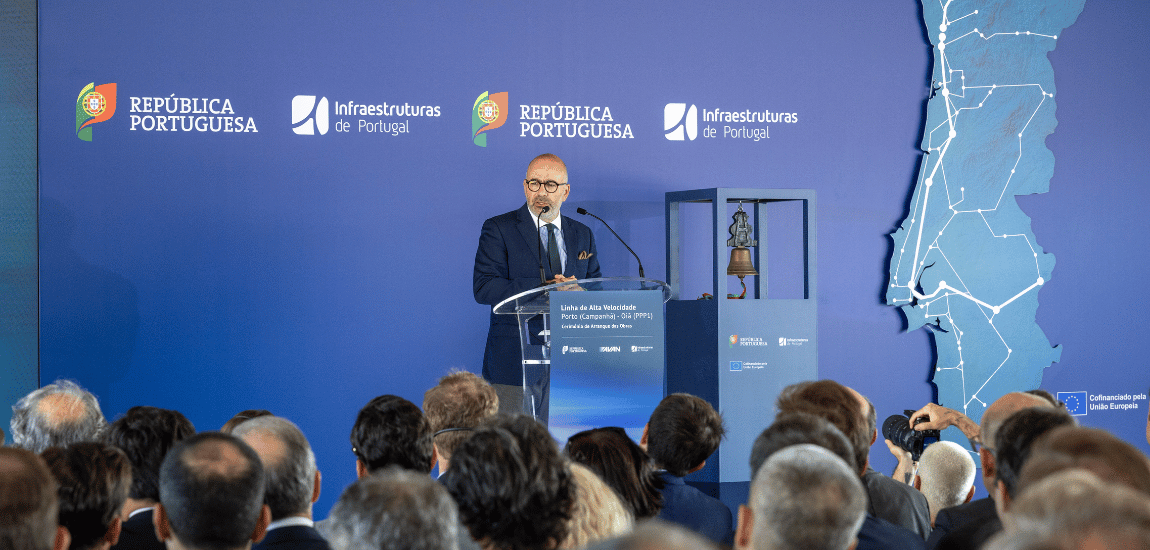
The initial construction phase covers a 71-kilometre stretch between Porto’s Campanhã station and Oiã, in the Aveiro district, with a new double-track, electrified railway designed to accommodate trains travelling at speeds of up to 300km/h.
Infraestruturas de Portugal (IP) says the project is part of a wider investment in the national railway network, with the ultimate ambition of connecting Porto and Lisbon in approximately one hour and 15 minutes.
A ceremony attended by Infrastructure and Housing Minister Miguel Pinto Luz, representatives of the European Commission, IP and the private consortium responsible for delivering the project, AVAN, marked the beginning of construction.
Faster journeys
Although faster journeys are one of the main attractions of the new railway, the project is also expected to address longstanding capacity problems on Portugal’s existing Northern Line.
By transferring the fastest long-distance services to a dedicated high-speed route, the Government hopes to free up space on the conventional railway for suburban, regional and freight trains.
Therefore, the infrastructure is expected to benefit passengers and businesses beyond the cities directly connected by the high-speed service.
The first concession also includes an additional 8.3km connection to the existing Northern Line near Canelas, providing access towards Aveiro and allowing the new infrastructure to work alongside the conventional railway network.
New stations
This project involves more than laying new railway tracks, including adapting Porto’s Campanhã station to accommodate high-speed services and constructing a new underground station at Santo Ovídio in Vila Nova de Gaia.
In addition, there are plans for around eight kilometres of tunnels and 19 kilometres of bridges and viaducts.
Among the most significant structures will be a new road and railway bridge across the River Douro.
At Campanhã, passengers will have access to the conventional Northern and Minho lines, five Porto Metro lines and the city’s intermodal terminal, while Santo Ovídio station will connect with two Porto Metro lines and a future bus terminal.
The connection near Canelas will also provide access to Aveiro’s existing railway station, which Infraestruturas de Portugal is due to adapt for high-speed services.
Connected municipalities
The Porto-Campanhã to Oiã section will cross ten municipalities, covering Porto, Vila Nova de Gaia, Santa Maria da Feira, Espinho, Oliveira de Azeméis, Ovar, Estarreja, Albergaria-a-Velha, Aveiro and Oliveira do Bairro.
Furthermore, the Porto-Lisbon project is also intended to connect with the Western Line, providing access to Leiria, as well as the conventional Northern Line, serving Aveiro and Coimbra.
This means the benefits of the investment are expected to extend beyond the main high-speed stations, improving connections for passengers travelling from several other parts of the country.
Concession award
AVAN was awarded the concession in July 2025 under a 30-year agreement with Infraestruturas de Portugal.
The first five years will cover the design, planning, licensing, financing, land acquisition, construction and certification of the infrastructure, with the aim of preparing it for operation.
Meanwhile, the remaining 25 years will focus on maintenance, conservation, and ensuring the railway remains available for use.
Paulo Carmona, IP Executive Chairman, described the start of construction as the transition from planning to delivering one of the most important railway infrastructure projects in Portugal.
He said the new connection would reinforce the country’s economic competitiveness, territorial cohesion and environmental sustainability, while bringing communities closer together and improving access to employment and investment opportunities.
Carlos Mota Santos, a representative of AVAN, also emphasised that the project is an opportunity to transform mobility across Portugal and strengthen the country’s connections with the rest of Europe.
He added that the consortium, made up exclusively of Portuguese companies, was proud to take responsibility for delivering infrastructure intended to serve future generations.
Transport ambitions
The Porto-Lisbon high-speed railway forms part of Portugal’s National Investment Programme 2030 and the European Trans-European Transport Network.
This project is receiving significant European financial support and involves cooperation between the Portuguese Government, Infraestruturas de Portugal, European institutions, municipalities and private companies.
For the Government, the investment represents an important step towards modernising the national railway network and improving Portugal’s integration into Europe’s transport system.
Set The Portugal News as your preferred source for news on Google
 Add as a preferred source on Google


 Portugal Handbook
 English
 Nederlands
 Deutsch
 Français
 Español
 Italiano
 Svenska
 Pусский
 中文
 Türkçe
 Português
 Czech
 Hungarian
 Polski
 عربي
 Suomi
 עִברִית
 Português (Brasil)

Follow us on social media