


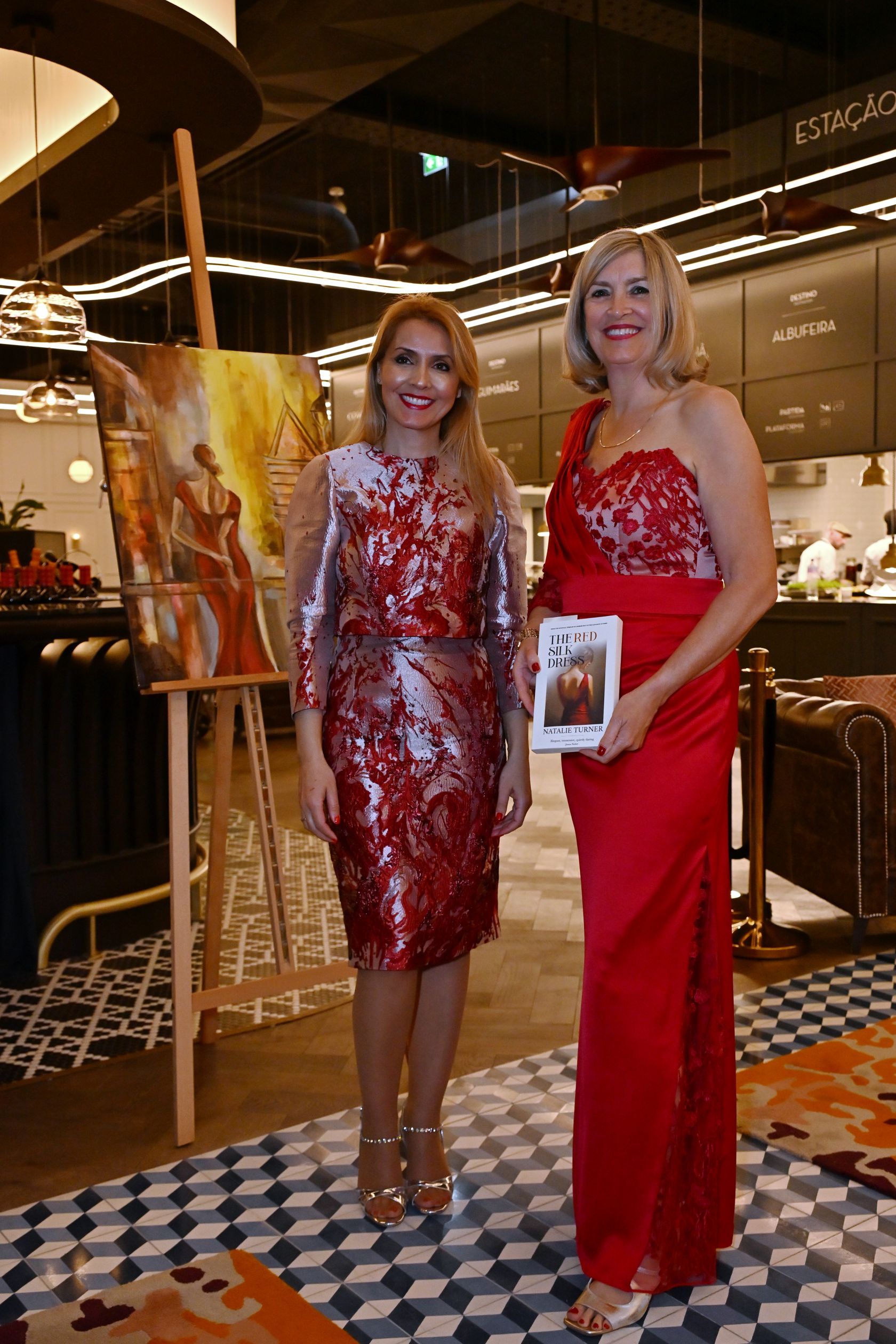
As I walked into the room at the Editory Riverside Santa Apolónia Hotel for the launch of my novel, The Red Silk Dress, one arm was bare; the other veiled in embroidered red flowers resting against my skin. The bodice followed the shape of my body, while the opening in the skirt offered only a glimpse of my leg.
The story had left the page. It was now present in words, form and cloth.
For eleven years, the novel lived inside me. It began in 2015 among the temples of Angkor Wat in Cambodia and travelled through countries, seasons and other work. I set it aside, sometimes for years, but it never disappeared. Some dreams lie beneath the surface of life until we are ready to recognise them again.
The dress began in conversation with Portuguese designer Catarina Castanho, founder of the brand Purple. Over tea, sketches, pieces of lace and shades of red, we sensed that we were not simply creating a garment. We were listening for its spirit. I wanted it to carry the novel’s inner and outer worlds, and Catarina intuitively understood how fabric could give form to the tension between what is seen and what remains hidden.
Design, fabric and silk run through The Red Silk Dress like an inner thread. Textiles folded in boutiques across Cambodia and Malaysia. Silk slipping through fingers. Colour catching in the market light.
Beneath it all lies the buried dream of Claudette, the novel’s protagonist, who longs to work with fashion and design.
In unfamiliar landscapes, a different sense of herself begins to emerge. The dream awakens quietly, through texture, colour, a glimpse of possibility.
Perhaps our deepest desires find us this way. Something touches the body, or the heart, before the mind can name what has stirred.
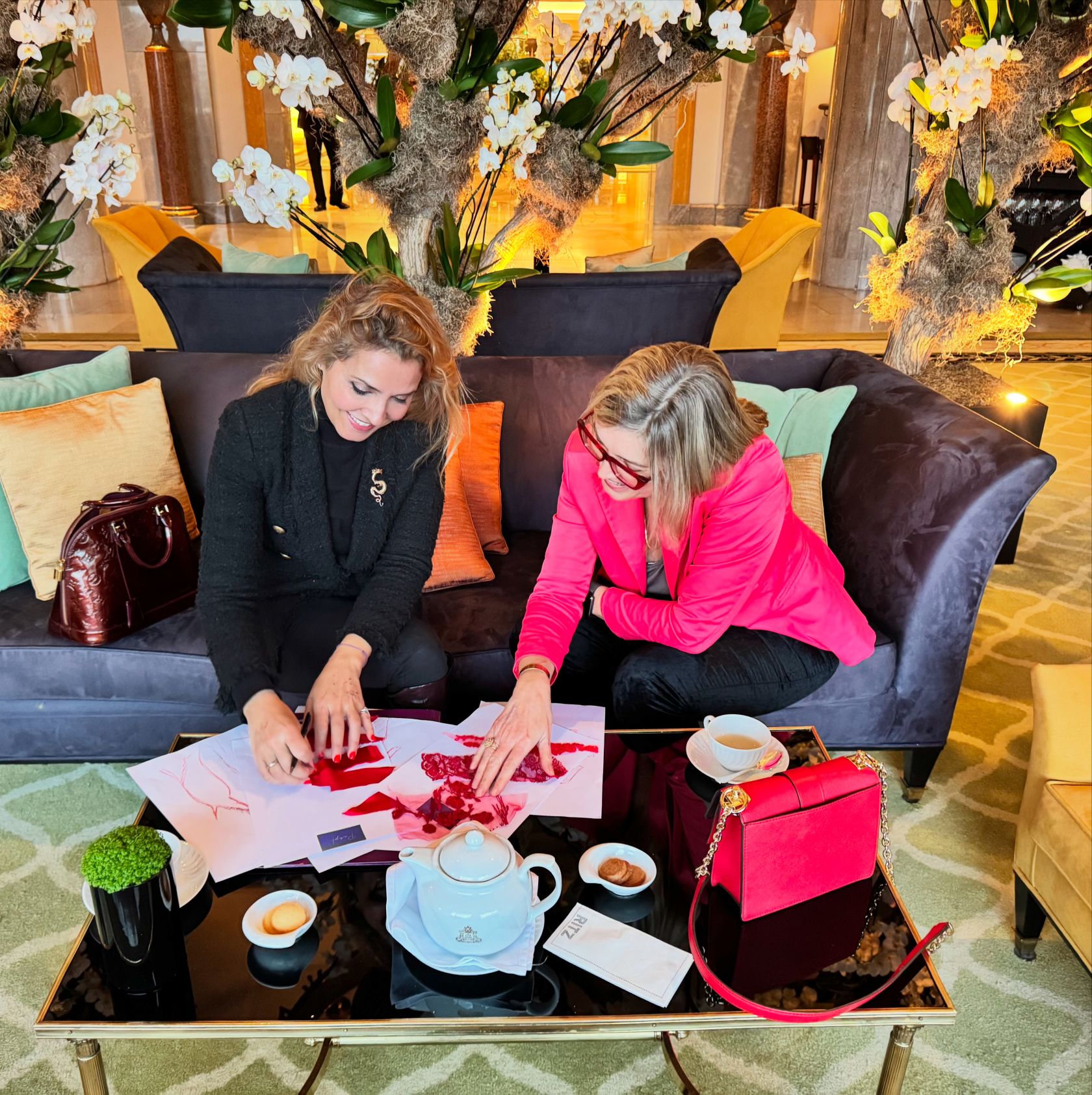
As a young woman, Catarina wanted to become a fashion designer. Life carried her into marriage, motherhood and law, and she built a legal career spanning more than twenty-five years. During that time, her daughter became seriously ill, and for six years the world revolved around care, fear and love.
When life opened again, fashion was still there. Catarina came to it carrying everything the intervening years had asked of her. She named her brand Purple, a colour she associates with transformation and growth, reflecting how deeply caring for her daughter had shaped her.
A long-held dream is never preserved untouched. It absorbs our losses, our courage and our discipline. We do not go back to meet it. We return as the person life has made us.
Catarina chose lace embroidered with flowers. Lace carries its own contradiction. It draws the eye while keeping something hidden. It belongs to intimacy and suggestion, to the quiet border between concealment and exposure.
In Portugal, lace and embroidery hold the memory of patient hands. Thread passing through cloth. Pattern emerging slowly. Beauty made through attention, often by women whose names have been lost to time.
Video Credit: Carl Hinds
The embroidered flowers spoke of blooming after difficulty. A sash crossed the body like a band of restraint, symbolising the forces that try to bind or contain us even as something within us begins to open. Yet the flowers continued beyond it.
They bloomed anyway.
The dress held both truths. The woman who longs to be seen. The woman who protects what is private. One arm veiled. One arm open. The body present, but never surrendered.
During the fittings, I watched the dress come closer to me through almost invisible decisions. A line softened. Lace settled against skin. A fold fell differently.
Writing is like this too. A word changes the temperature of a paragraph. A pause reveals what a character cannot say. Little by little, the work begins to breathe.
At the final fitting, I stood before the mirror. Between Claudette, the woman I had imagined, and my own reflection, the woman who had carried her for eleven years, the distance seemed to narrow. Her longing had shaped my writing. My life had shaped hers. Catarina’s hands allowed the two worlds to touch without becoming one.
That night, the red dress moved with me through the room. Behind me, a painting born of the novel. In my hands, the book. Around me, the people who had come to witness its arrival. The story was no longer mine alone. It had entered other imaginations. It had become colour, conversation, memory.
Later, over lunch, Catarina reflected on the dream she had carried since her youth, still alive after all that had come between.
The thought stayed with me as I walked towards the ferry at Cais do Sodré. Near Time Out Market, I passed a flower shop and saw proteas, the same flowers my husband, Carl, had sent me a decade earlier, when the novel was still in its early pages. One fully open. One still becoming.
Sometimes the threads of a life only become visible when we look back. A story first imagined within ancient temples. A designer returning to the dream she first held as a teenager. A dress created to carry a novel into the world. None began together. Yet, for a moment, they touched.
Perhaps a dream does not chase us from behind. Perhaps it travels within us, changing shape as we do, waiting until we are ready to recognise it. Then it asks for form.
A story. A dress.
A life large enough to hold it.
To find out more about The Red Silk Dress or register your interest in future Red Silk salons and gatherings of story, art and conversation, visit
www.theredsilkdress.com.

About Natalie Turner
Natalie Turner is a British author based in Lisbon. Her debut novel, The Red Silk Dress (February 2026), explores identity and longing. She also works internationally as a leadership advisor and is the founder of Women Who Lead.
Main image credit: Natalie Turner reading from The Red Silk Dress during the first Red Silk Salon at The Vintage. Photo: Joaquim Morgado
 Add as a preferred source on Google





 Portugal Handbook
 English
 Nederlands
 Deutsch
 Français
 Español
 Italiano
 Svenska
 Pусский
 中文
中文 Türkçe
 Português
 Czech
Czech Hungarian
 Polski
 عربي
عربي Suomi
Suomi עִברִית
 Português (Brasil)
Follow us on social media