


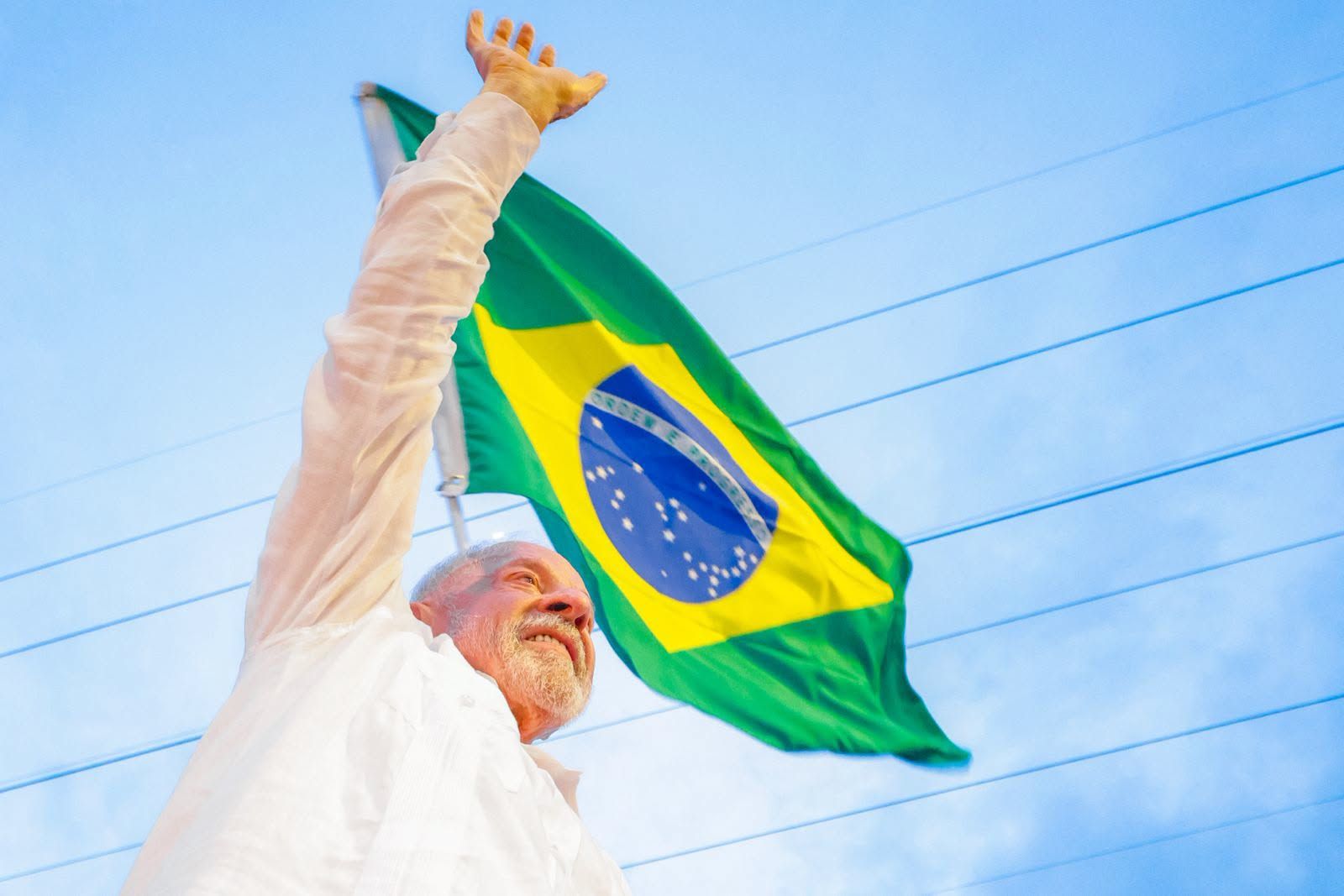
Lula da Silva received 63,388,523 votes, compared with 59,099,143 for Flávio Bolsonaro, with 98.76% of polling stations counted.
The left-wing Workers’ Party (PT) leader and former trade unionist was re-elected at the age of 80, having overturned a deficit of more than two million votes from the first round.
In the first round, held on 4 October, right-wing candidate Flávio Bolsonaro secured 47.03% of valid votes, compared with 45.16% for Lula da Silva, giving him a lead of 2,224,965 votes. Since Brazil introduced the two-round presidential election system in 1989, no candidate who finished second in the first round had managed to win the election.
Student movements
Immediately after the first-round defeat, an unprecedented mobilisation, driven by students, spread across several sectors of society and filled the streets of cities throughout Brazil in support of Lula da Silva’s re-election.
On the final day of campaigning, Lula brought hopes of an upset from the seafront to the heart of São Paulo, turning Avenida Atlântica in Copacabana and Avenida Paulista red. According to PT estimates, which have not been independently verified, the two marches drew 1.15 million and more than two million people, respectively, in a final push to turn street support into votes.
On election day, 25 October, before casting his ballot at a school in São Bernardo do Campo, in the state of São Paulo, the birthplace of his political career, Lula acknowledged the mobilisation.
“What the people have done for me over these past few days is something that cannot be repaid. It is an enormous amount of generosity, affection and love, and I will be eternally grateful for the way the people have behaved,” he said.
Lula da Silva’s second-round campaign was marked by strong mobilisation on social media, in the streets, through demonstrations organised by artists, and via initiatives led by students and social movements aimed at winning votes and combating abstention.
Following his first-round deficit, he focused on defending democracy and his social legacy, stepped up his attacks on his opponent and announced economic and labour measures in an effort to overturn the result.
Right-wing demonstrations
Flávio Bolsonaro combined displays of strength on the streets with a strong focus on social media, mobilising digital influencers and figures such as MP Nikolas Ferreira to extend the campaign’s reach.
He also secured the support of candidates defeated in the first round, including Ronaldo Caiado, Romeu Zema and Augusto Cury, who collectively received 5.34% of valid votes, as well as former President Michel Temer and the country’s main centrist political parties.
Battle on social media
The contest also extended to digital platforms, with Lula’s campaign accusing Meta, the owner of Facebook, Instagram and WhatsApp, of favouring Flávio Bolsonaro.
The campaign also turned to the Superior Electoral Court to demand equal treatment for both candidates, denouncing account restrictions, content removals and shortcomings in artificial intelligence tools.
More than 158.7 million voters were registered to vote on 25 October at approximately 564,000 electronic voting machines across the country’s 5,571 municipalities, as well as in 186 cities abroad, including Lisbon, Porto and Faro.
Brazilian voters in Portugal
In Portugal, 134,797 Brazilian voters are registered to vote, with polling stations available only in Lisbon, Porto and Faro.
Of these, 78,883 voters are registered in Lisbon, 47,676 in Porto and 8,288 in the Algarve. Brazilian voters residing in other Portuguese districts or cities can travel to one of the three aforementioned cities to cast their ballots. When registering to vote, each voter is also informed of the city they must travel to in order to exercise their right to vote.
Brazil’s presidential election also prompted demonstrations outside polling stations, leading to tensions between supporters of Lula da Silva and Flávio Bolsonaro. One of Lula da Silva’s underage supporters was reportedly assaulted by a supporter of Flávio Bolsonaro.
Set The Portugal News as your preferred source for news on Google
 Add as a preferred source on Google


 Portugal Handbook
 English
 Nederlands
 Deutsch
 Français
 Español
 Italiano
 Svenska
 Pусский
 中文
 Türkçe
 Português
 Czech
 Hungarian
 Polski
 عربي
 Suomi
 עִברִית
 Português (Brasil)

Just goes to show how keen Brazilians were to avoid Bolsonaro winning. There must have been voters switching to Lula between the first and second rounds to generate such a decisive victory. Bolsonaro's association with and support for Trump wouldn't have helped him. After three terms and aged 80, Lula ought to have been a spent force, his retirement long overdue, so Brazilians would almost have elected a donkey to keep Bolsonaro out. I wonder if his father's fall from grace, culminating in a long prison sentence somehow poisoned his chances, and him standing as the son of a former President smacks of nepotism.
By Billy Bissett from Porto on 26 Oct 2026, 11:29
Thank you free thinking Brazilians! Now the work really begins to address the inquities that drove so many to vote for the fascist oligarchs.
By JoeT from Algarve on 26 Oct 2026, 12:46