


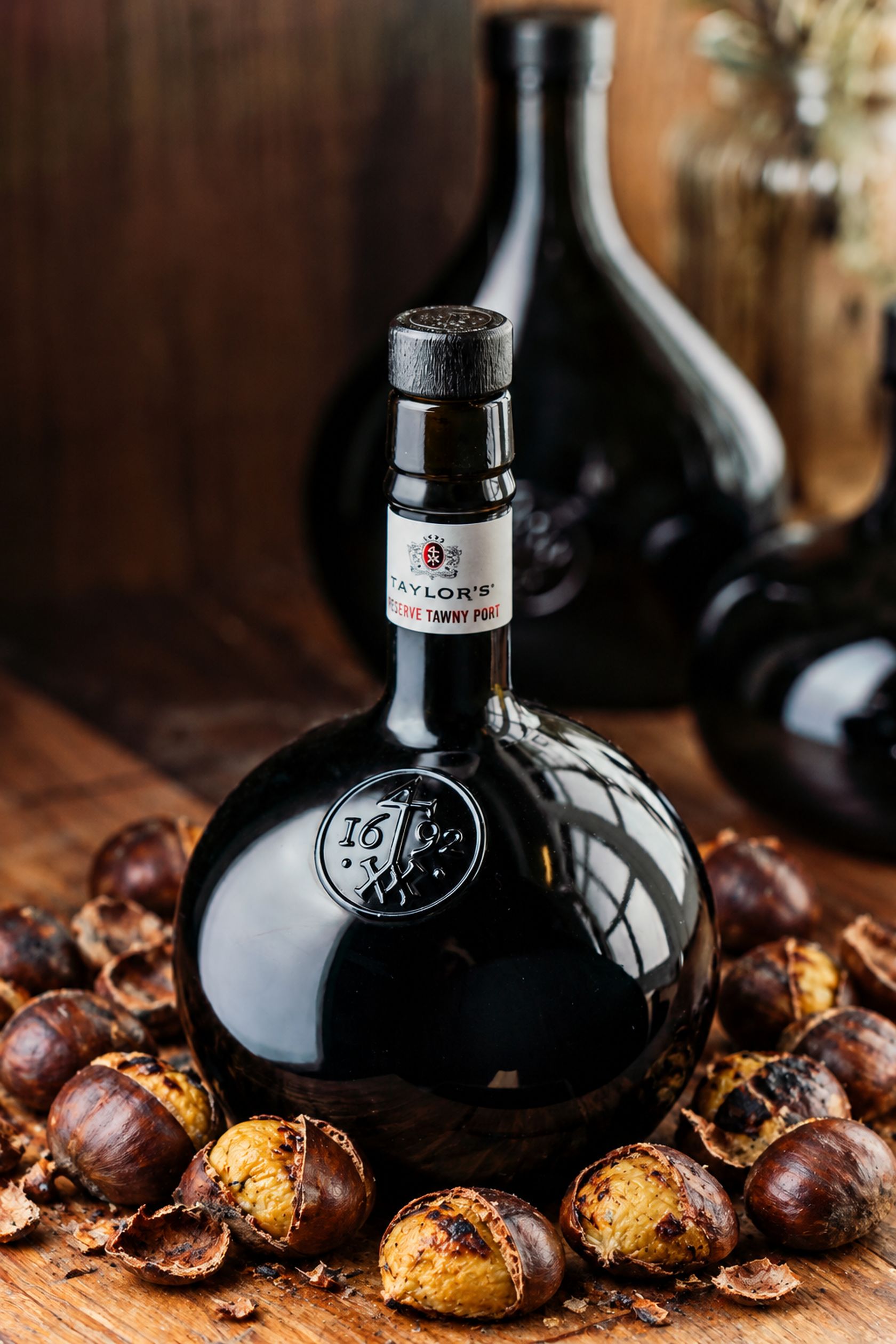
On the 5th of November, bonfires are lit in towns and villages across the UK to mark the Gunpowder Plot of 1605, with warm drinks shared around the flames, including the occasional mulled Port. Six days later, Portugal lights fires of its own for São Martinho, and Taylor’s Historical Collection IV – The Globe, a cask-aged Reserve Tawny, is made for both. Its bottle is modelled on the English wine bottles of the early-1600s, when Job Bearsley, who went on to found Taylor’s in 1692, was living in Viana do Castelo, in the north of Portugal.
On São Martinho, the smell of sweet scented wood is thick in the air in Portugal. From the chestnut sellers’ blackened braziers on city street corners to bonfires in the villages of Trás-os-Montes, the feast arrives with ‘castanhas assadas’ (roasted chestnuts) in paper cones, fingertips smudged with ash and, best of all, a glass of Taylor’s tawny close at hand.
The day honours Martin of Tours, the Roman soldier who, legend tells, cut his cloak in two to shelter a freezing beggar from a winter storm and then received a vision of Jesus wearing half a cloak. Portugal still calls the mild spell that so often arrives in mid-November the Verão de São Martinho and still marks the day with a magusto: family, friends, a fire and the season’s chestnuts. As the old saying goes, “No dia de São Martinho, castanhas, pão e vinho” "(On the day of São Martinho, chestnuts, bread and wine)”.
The chestnut, with its sweet, smoky, faintly nutty flesh, is a perfect match for a fine Taylor’s Reserve tawny.
A History Told in Glass
Taylor’s Historical Collection is a series of specially blended, cask-aged Ports presented in bespoke bottles modelled on historic bottle moulds. Together, they trace how the wine bottle evolved through the seventeenth and eighteenth centuries, from the squat, globular vessels that carried wine from the merchant’s cask to the table, to the tall cylindrical bottle in which wine is cellared today.
The first edition, released in 2017 for the company’s 325th anniversary, revived the bulbous ‘onion’ bottle in use when Taylor’s was founded in 1692. The second, fittingly for this season, was The Chestnut, modelled on the flat ‘chestnut’ flagons made in England from around 1715 to 1740. The Mallet followed, recalling a shape well established by the 1730s.
The fourth edition, The Globe, reaches back furthest of all. It is inspired by the ‘shaft and globe’ bottles of mid-seventeenth-century England, mouth-blown rather than moulded, and made sturdier as glassmakers moved from wood-fired to coal-fired furnaces. Thick-walled and spherical, they were made for storing and serving wine and were the forerunners of the onion bottle. Each bottle is engraved with ‘4XX’, a reference to the company’s earliest known trademark.
A wine for the magusto
Taylor’s Reserve Tawny is a limited blend, matured in seasoned oak casks in the company’s lodges. In the glass it shows a deep reddish-brown core with a narrow brick rim. The nose opens with coffee, butterscotch and dried fruit, plum and raisin, surrounded by layers of spice, wood and nuts and a discreet floral lift. The palate is round, dense and silky, with toffee and preserved fruit flavours carrying into a long, warming finish.
That profile is exactly why it belongs beside the magusto fire. Taylor’s Reserve Tawny with roasted chestnuts, still warm from the brazier, is a natural combination, its sweetness meeting the wine’s nutty, toffee notes. Serve it slightly chilled, between 12°C and 16°C. It is ready to drink, needs no decanting and once opened, keeps its freshness for around two months.
Guardians of Port Since 1692
If the bottle tells the story of wine’s vessels, the wine tells the story of a family. Taylor’s was founded in 1692 by the English merchant Job Bearsley and has remained independent ever since. In 1744, Bartholomew Bearsley became the first British shipper to buy a property in the Douro, near Régua.
In the nineteenth century, Joseph Taylor gave the firm its name and chose John Fladgate and Morgan Yeatman to succeed him; a partnership deed of 1838 created Taylor, Fladgate & Yeatman. Several of Fladgate’s daughters married into other Port families, among them the Guimaraens. Frank Yeatman rebuilt Quinta de Vargellas and steered the house through two world wars, and in 1934 the cousins Dick and Stanley Yeatman introduced Chip Dry, the first dry white Port.
Alistair Robertson, Huyshe Bower and Bruce Guimaraens then led Taylor’s into a new era, launching the first Late Bottled Vintage in 1970, purchasing new vineyards, opening new markets and expanding the age-dated Tawnies in 1973. Today the next generation carries the story on: Natasha Bridge, Alistair’s daughter; Robert Bower, Huyshe’s son; and head winemaker David Guimaraens, Bruce’s son, under the leadership of the CEO Adrian Bridge.
So, this São Martinho, as the chestnuts crackle and split over the coals, there is something fitting about pouring a wine from a bottle whose design is as old as the Port trade itself. The shape of the bottle has changed many times since the days of the shaft and globe. The fireside, the shared table and the patience of a family Port house remain very much the same.
Discover more at www.taylor.pt
Set The Portugal News as your preferred source for news on Google
 Add as a preferred source on Google


 Portugal Handbook
 English
 Nederlands
 Deutsch
 Français
 Español
 Italiano
 Svenska
 Pусский
 中文
 Türkçe
 Português
 Czech
 Hungarian
 Polski
 عربي
 Suomi
 עִברִית
 Português (Brasil)

Follow us on social media