


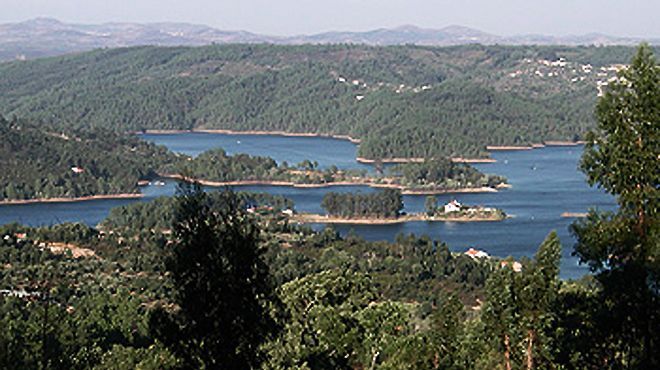
This project is located a short distance from the huge dam at Castelo do Bode which was built in 1951 to repress the waters of the River Zêzere for a northerly distance of 60 km. The principal objectives were to (a) provide a source of hydro-electric power (b) quench the need for potable water for 2.5 million citizens living to the south as far as Greater Lisbon and (c) assist by irrigation the farming of the rich soil in the central region.
During the next forty years, the immense scenic beauty of the flooded valley attracted visitors from other regions of Portugal who enjoyed the pleasures of bathing, boating and fishing in the pristine waters. Some of the wealthier bought or rented housing along the margins but this was limited by strict regulations which confined construction to restricted zones situated beyond 35 metres of the highest water level and imposed conditions which restricted design and materials to being of national character.
In the 1990s, this delightful and somewhat secretive national asset became known to tourism and attracted proposals from operators who were appalled by the lack of hotels and residential accommodation. Some of these attempted the rehabilitation of estalagens (inns) such as Ilha de Lombo, Lago Azul and Vale de Ursa while some new projects bordered on the fanciful e.g. Swiss cable cars and Dutch helicopters to connect American style resorts, a prefabricated replica of Almourol castle to provide a scenario for medieval banquets and jousting and submarine tours by glass bottomed boat to assist scuba divers to visit underwater ruins.
The Vale Paraiso Eco-Resort was first mooted in year 2004 by Portuguese entrepreneurs who had secured an option to buy over 53 hectares of woodland which occupied the ridge of a promontory on the Tomar side of the lake. It received support from that municipality which agreed to co-operate with the provision of services for sanitation, electricity and roads.
Little progress was made until year 2015 when the initial environmental process entered the regulatory pipeline with a completely restructured design supported by economic feasibility studies. This detailed a total capacity of 190 accommodation units of villas, town-houses and apartments occupying 30,000 m2 surrounded by a green area of nearly 90,000 m2. These combined to serve a miniature port with private marina, commercial centre and sports areas. At a later date a clinic and school were added.
To attract global investors and resort managers, a professional video presentation was made which included 3D virtual models. These showed some of the properties in modernistic “eco-style” with garden roof-tops and much vegetation. One could be forgiven for comparing this to the location built for “The Time Machine” science-fiction film of1960 which depicted a village (larder) occupied by the young vegetarian Elois who were to be devoured by the underground (water?) Morlocks.
However, this illusory allusion did not deter many wealthy foreigners who were convinced that this was a golden opportunity to join a “waiting list” by paying a substantial non-refundable deposit which could be sold, possibly at a premium, should they wish to withdraw as subscriber to the capitalist venture.
The assumptions that the success of the project was assured have been shattered by the realisation that the much delayed regulatory management plan (Plano de Ordenamento) will proscribe the building of such large tourist complexes for the length of the Albufeira. This would place the developers in the unenviable position of having their project frozen while interminable legal appeals proceed.
A return to the halcyon days of the 20th century is clearly impossible but preservation of a “national treasure” is a policy with which most local people would concur.
 Add as a preferred source on Google







 Portugal Handbook
 English
 Nederlands
 Deutsch
 Français
 Español
 Italiano
 Svenska
 Pусский
 中文
中文 Türkçe
 Português
 Czech
Czech Hungarian
 Polski
 عربي
عربي Suomi
Suomi עִברִית
 Português (Brasil)
The publication of this essay has drawn observations from Quercus, a national environmental entity, that it considers the matter to be scandalous and will insist that the Vale de Paraiso project is halted until an Avaliation of Abiental Impact has been made.
By Cavaleiro R. from Other on 10 Jul 2026, 12:15