


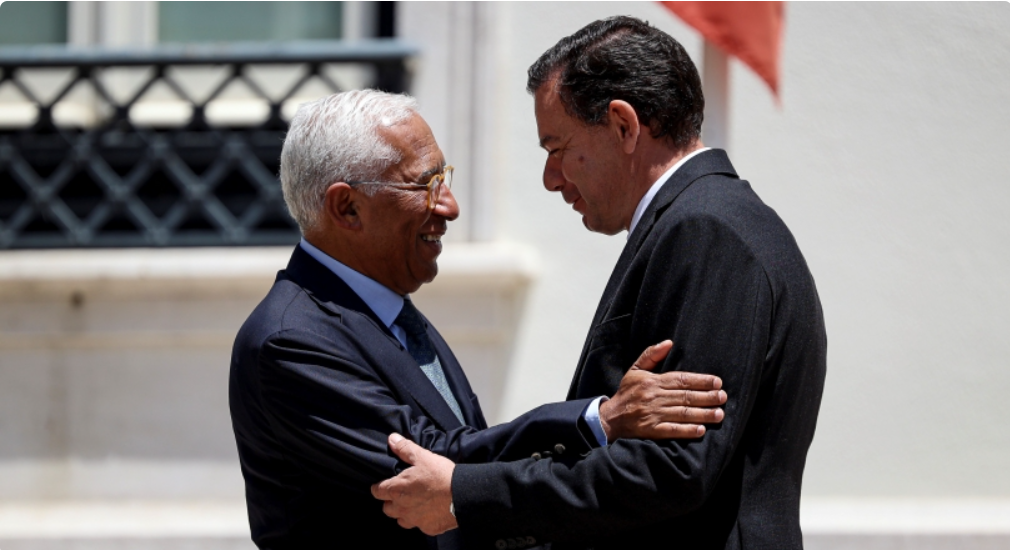
This would allow Costa, the former Portuguese Prime Minister, to remain in office for another two and a half years, Executive Digest reports.
According to Expresso, a government source assures that there is “full support from the Prime Minister and the Government” for António Costa to remain on the European Council.
The government also supports Roberta Metsola to remain as President of the European Parliament.
Preserving current EU posts
Montenegro aligns with the solution advocated by Manfred Weber, president of the group and of the EPP, who intends to maintain the current distribution of the main European posts until the end of the legislature in 2029.
Under this scenario, António Costa, of the Socialists and Democrats (S&D), would remain at the head of the European Council, Roberta Metsola, of the EPP, would remain as president of the European Parliament, and Ursula von der Leyen, also of the EPP, would continue to lead the European Commission.
Current trio of EU presidents
According to several European sources cited by Expresso, Manfred Weber met with António Costa last week and subsequently argued to the EPP parliamentary group that the Portuguese leader should be re-elected in the spring.
Weber believes that the current trio of presidents is functioning well and that it is in the EPP’s interest to preserve the existing balance. According to Expresso, there is currently no internal opposition to this within the EPP parliamentary group.
As it occurred in 2024, Montenegro shows support for Costa before the socialist himself has even publicly announced whether he intends to remain in office or not.
Test of Costa’s mandate
A European source, quoted by Expresso, assures that Costa is focused on his current mandate and on reaching an agreement on the next EU budget; negotiations on the financial framework for 2028-2034 are seen as one of the main tests of Costa’s mandate.
The member states’ positions remain divided, with the Nordic countries advocating for significant cuts and Southern countries seeking to preserve funds allocated to Cohesion.
Metsola’s influence on negotiations
Roberta Metsola’s presence in the European Parliament is an important part of this negotiation, as her term ends in mid-January 2027, making a decision necessary in the near future.
The allocation of key European posts traditionally attempts to reflect a balance between different political families. Therefore, a potential departure of Metsola could reopen the debate about the leadership of the European Council.
Governments led by Socialists
The Socialists remain the second largest force in the European Parliament but have lost influence among the heads of government of the European Union, especially after losing control of the German chancellery, Executive Digest reports.
Among the 27 European leaders, only Spain, Malta, and Denmark currently have governments led by socialists. According to Executive Digest, this number is expected to increase to four with the return of Sweden’s Magdalena Andersson.
The EPP has eleven leaders and the liberals have four.
 Add as a preferred source on Google







 Portugal Handbook
 English
 Nederlands
 Deutsch
 Français
 Español
 Italiano
 Svenska
 Pусский
 中文
中文 Türkçe
 Português
 Czech
Czech Hungarian
 Polski
 عربي
عربي Suomi
Suomi עִברִית
 Português (Brasil)
Follow us on social media