


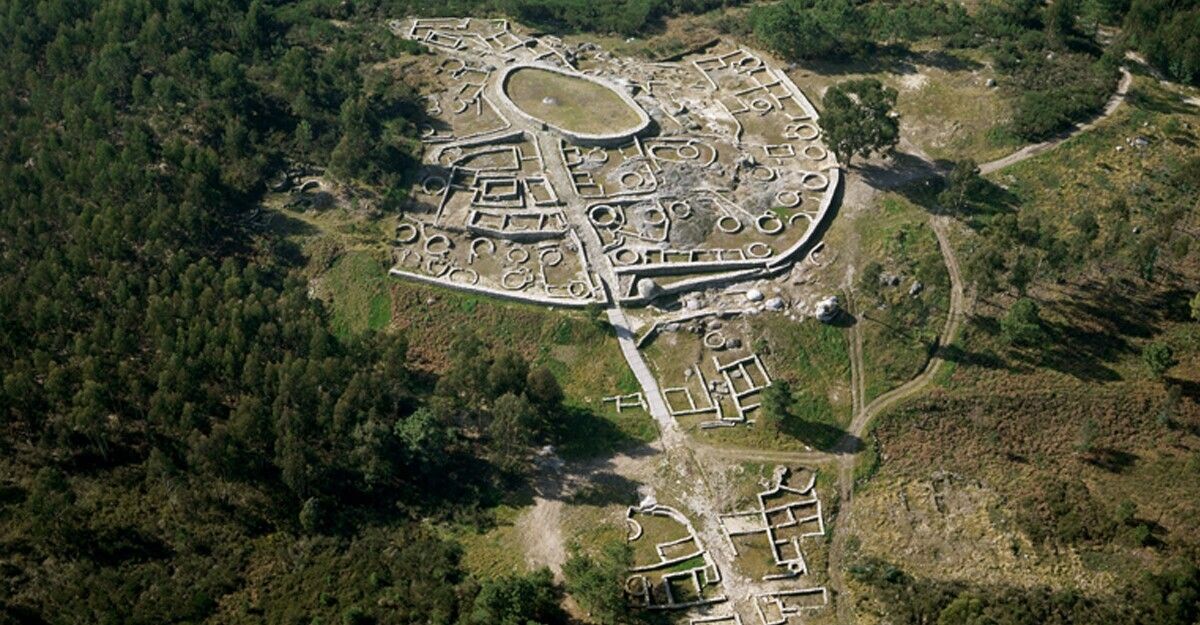
Known as Castro de Monte Mozinho, or the “Dead City”, it is one of the largest Roman-era fortified settlements in northern Portugal. Today, its stone walls, old streets and the remains of former homes offer visitors a glimpse into how people once lived there.
The settlement stands 408 metres above sea level and extends across approximately 22 hectares—an area roughly equivalent to 30 football pitches. It crosses the parishes of Galegos, Oldrões and Valpedre.
Its history dates back to the end of the first century BC and the beginning of the first century AD, when the north-western Iberian Peninsula was becoming part of the Roman world.
Although Roman influence gradually changed the settlement, its inhabitants initially held on to older traditions. Some of the first houses were circular, following the style associated with the pre-Roman castro culture. Over time, new forms of architecture appeared, along with streets, defensive walls and spaces used for everyday and community life.
The most important area stood at the top of the hill. Among the archaeological finds discovered there were granite sculptures representing Galician warriors.
Evidence suggests that people began leaving the settlement from around the fifth century. Some moved to lower and more open areas, while others left the region entirely.
Archaeological work carried out during the 20th century uncovered the remains of homes, coins, pottery and other objects once used by the people who lived there.
The open-air ruins can be visited free of charge. The Castro de Monte Mozinho Interpretation Centre was created in 2004 to help visitors understand the history and importance of the site.
The centre is linked to the Municipal Museum of Penafiel, which is currently undergoing renovation. Visitors should check the latest information before travelling, as access to the interpretation facilities may be restricted.
 Add as a preferred source on Google







 Portugal Handbook
 English
 Nederlands
 Deutsch
 Français
 Español
 Italiano
 Svenska
 Pусский
 中文
中文 Türkçe
 Português
 Czech
Czech Hungarian
 Polski
 عربي
عربي Suomi
Suomi עִברִית
 Português (Brasil)
Follow us on social media