


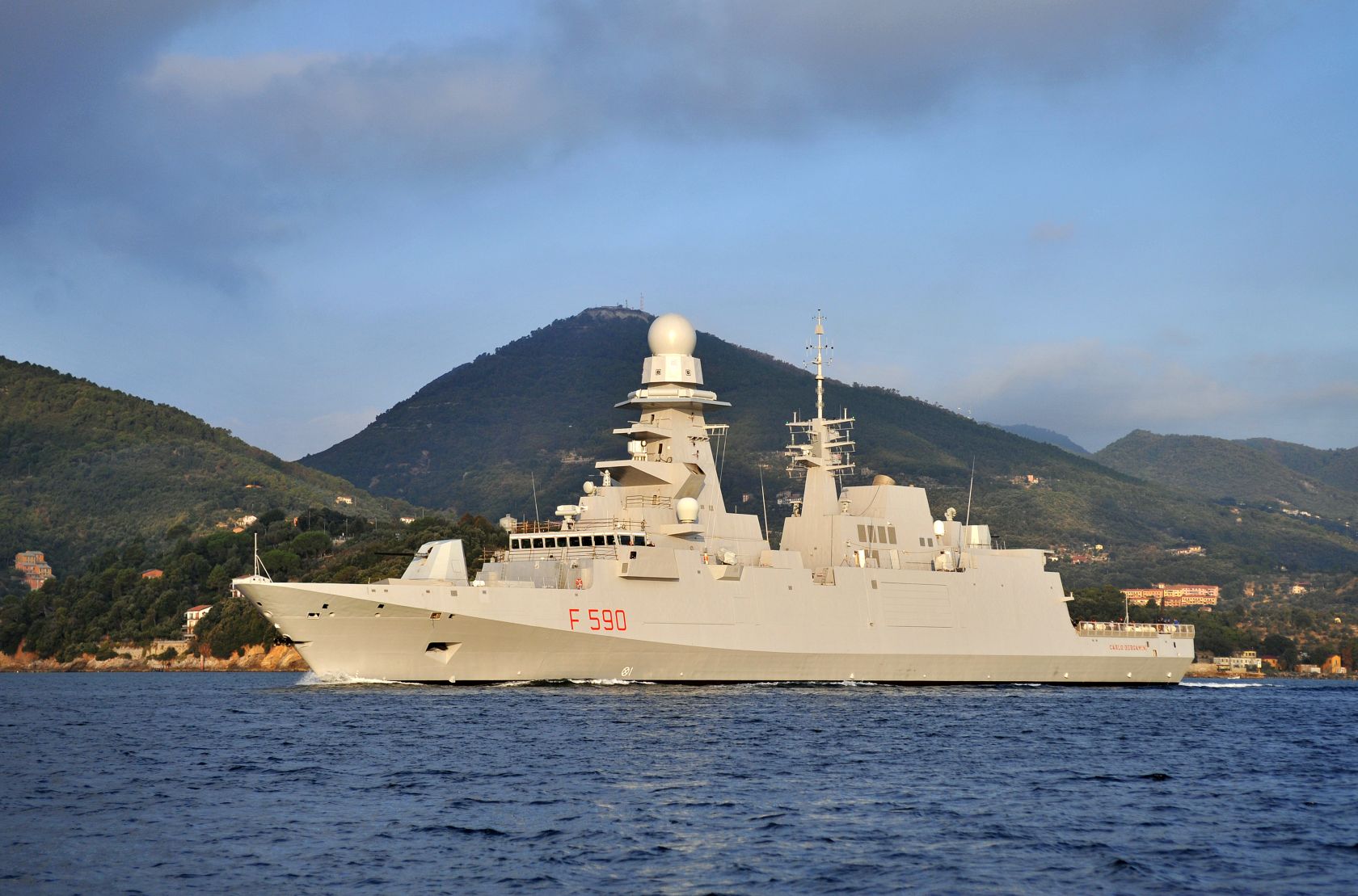
On 20 July, Prime Minister Luís Montenegro went to Rome to announce Portugal’s largest military investment in the country’s democratic history. The investment, worth €3.9 billion, is for the acquisition of three high-tech FREMM EVO frigates, with delivery scheduled between 2029 and 2030.
The vessels will replace three of the five Vasco da Gama-class frigates that entered service in the 1990s and are approaching the end of their service life, Euronews reports.
Portugal is the first foreign state to purchase this new model, manufactured by Fincantieri, which is owned by an entity controlled by the Italian Ministry of Economy and Finance. The only other order was from the Italian Navy itself, which contracted the first two units in July 2024.
Modern naval warfare
The frigates are designed to meet the challenges of modern naval warfare, with advanced digital systems allowing high-speed data processing and updates. Their capabilities include disrupting enemy communications, countering drone swarms and carrying out long-range attacks.
The deal accounts for nearly 70 per cent of the 5.8 billion euros allocated by the European Union to Portugal under the SAFE loan programme. The defence minister has already admitted that the price of the three frigates is “potentially higher” than the Italian deal. Based on the official data released so far, Portugal will spend at least 250 million euros more per frigate compared to Italy.
Portugal and Italy compared
The defence minister attributes the potentially higher price to the specific operational requirements of the Portuguese Navy and SAFE funding, which requires costs to be calculated based on projected inflation for the delivery dates in 2029 and 2030, Euronews reports.
According to Prime Minister Luís Montenegro, the construction of the three ships will cost between €3 billion and €3.1 billion, more than one billion per unit, with the remaining €800 to €900 million reserved for logistics and maintenance components.
Italy ordered two FREMM EVO frigates in 2024 for a total value of approximately 1.5 billion euros, or 750 million euros per frigate. Based on the figures released so far, the Portuguese State is therefore paying a unit price 33 per cent higher than under the Italian contract for equipment that Euronews reports has a similarity of 95 per cent.
Why Portugal pays more
Brás Monteiro, who leads NATO’s pre-contractual technical analyses supporting the planning of military acquisition programmes, points out that the two countries are in different situations.
Montenegro also stated that Italy already has ten FREMM frigates operating with trained personnel in a “complete structure equipped with maintenance, infrastructure, stocks, and a consolidated industrial base” for this type of vessel. Portugal, on the other hand, “is starting practically from scratch” with these types of frigates and will have “initial costs that the Italian operator does not face in the same proportion.”
Set The Portugal News as your preferred source for news on Google
 Add as a preferred source on Google








 Portugal Handbook
 English
 Nederlands
 Deutsch
 Français
 Español
 Italiano
 Svenska
 Pусский
 中文
中文 Türkçe
 Português
 Czech
Czech Hungarian
 Polski
 عربي
عربي Suomi
Suomi עִברִית
 Português (Brasil)
Follow us on social media