


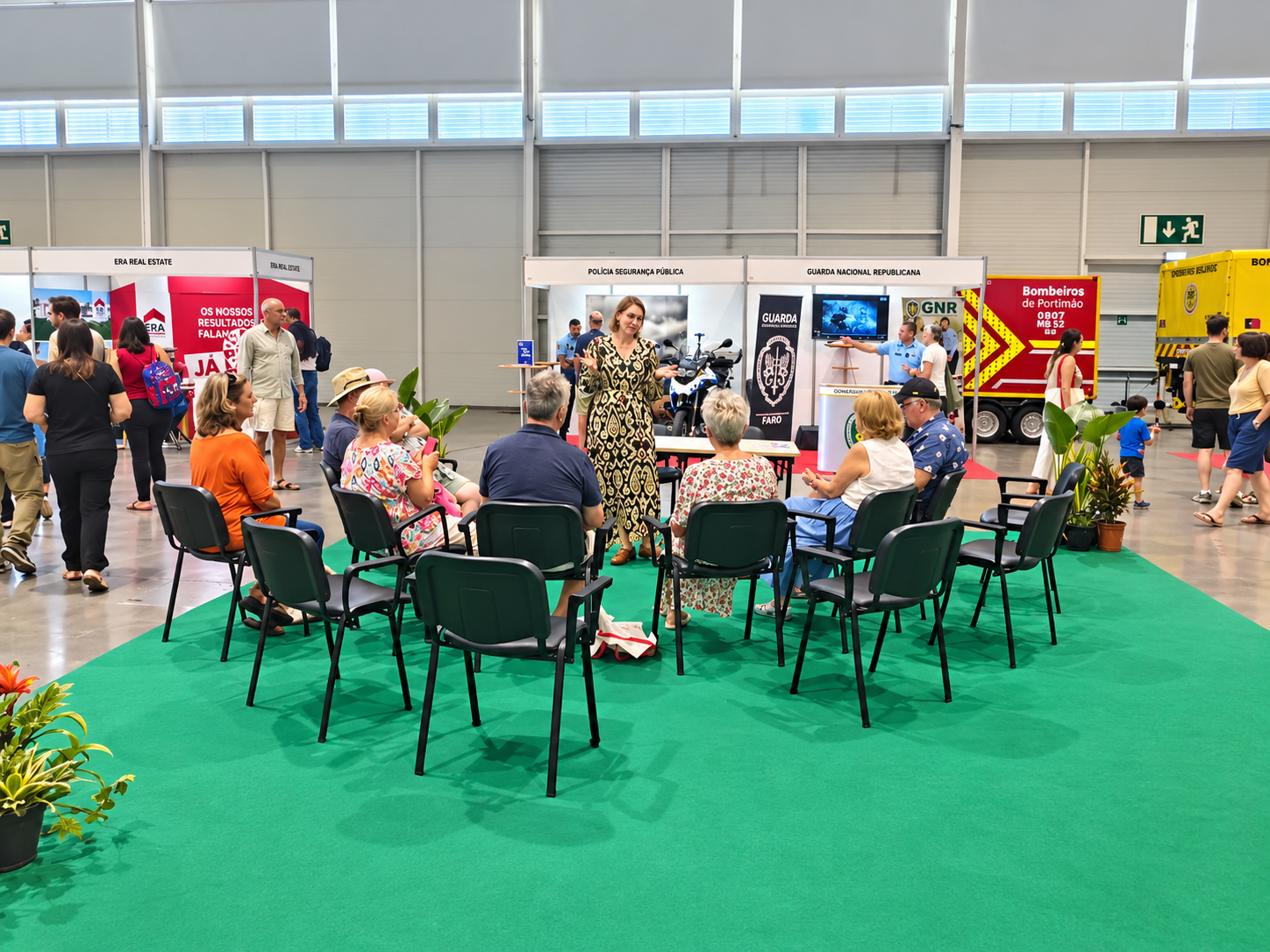
The two-day event brought together more than 100 national and regional organisations offering services to support people living in Portugal. British Consular Services was proud to join other consular representatives in the Algarve, including those from Ireland, Germany, Italy and the United States, to give informal presentations and answer questions from their communities.
The Expo gave British Consular Services in Portugal a valuable opportunity to engage directly with British nationals, hear about their experiences, and share practical information and guidance.
Thank you to AFPOP for organising another successful event and to everyone who visited our stand. It was a pleasure to meet you.
The following questions and responses reflect the themes I had prepared for the session. Rather than delivering them as a formal presentation, I used the information to guide informal conversations with participants and respond to their questions.
Many people will know the Embassy in Lisbon, as well as the Vice Consulate here in Portimão. Can you tell us why the Vice Consulate is in Portimão, and what its role is?
Our presence in the Algarve actually goes back quite a long way. The Consulate in Portimão was established in 1965 by José Pearce de Azevedo, who lived locally and served as British Consul until 1974.
Over the years, there have been a number of Consuls based in the Algarve. Following a restructure in 2012, we moved to a single Portugal-wide consular network, led by a Consul in Lisbon with Vice Consuls in both Lisbon and Portimão. That’s when the Consulate here became the Vice Consulate.
More recently, I took up the role in 2024 following Clive Jewell, who served in the Algarve for almost 15 years.
The reason we maintain a permanent presence here is quite simple. Around half of all British residents in Portugal live in the Algarve, approximately 23,000 people, and the region is also Portugal’s biggest destination for British tourists, welcoming over 1.2M British visitors every year.
Being based here means we are close to the people we support and close to the organisations we work with, whether that’s local authorities, emergency services, hospitals, charities, community groups such as AFPOP, or the tourism sector. Those relationships are incredibly important in helping us support British nationals when they need us.
What support do you offer British nationals? What do you do as part of the British Consular Services?
Many people associate consular work with passports and visas, but actually we don’t provide either of these services.
At its heart, consular work is about supporting British nationals and their families when they find themselves in difficult or unexpected situations overseas.
The most common reasons people contact us include welfare concerns, medical emergencies and hospitalisations, deaths abroad, missing persons, victims of crime and arrests or detentions.
By far the largest area of our work is supporting vulnerable people. That might be someone who is isolated, experiencing mental health difficulties, facing homelessness, or becoming vulnerable because of age, illness or a sudden change in circumstances.
We can’t solve every problem, but we can often make a real difference by helping people understand their options, connecting them with the right support, and ensuring they don’t have to navigate a difficult situation completely alone.
Many British nationals assume the Consulate can resolve administrative issues on their behalf. What can the Consulate help with, and what falls outside your remit?
In simple terms, our role is to support vulnerable British nationals and provide information, guidance and signposting.
We’re here to help people understand their options and connect them with the organisations that are responsible for dealing with a particular issue.
What we can’t do is intervene in Portuguese administrative or judicial decisions. We cannot speed up residency applications, obtain residence permits or drivers’ licences, register vehicles, overturn fines, or influence decisions made by Portuguese authorities.
That said, we do engage regularly with organisations such as AIMA, IMT and other Portuguese authorities. Where we identify issues affecting larger numbers of British nationals, we raise concerns, share feedback and seek clarification on policies and processes. Whilst we cannot resolve individual cases, we can help ensure that the concerns of the British community are understood at an institutional level.
What are the biggest challenges you see affecting British nationals living in Portugal today?
Interestingly, they’re not usually the issues that make the headlines.
The challenges we most commonly encounter involve health issues, social isolation, financial vulnerability and difficulties accessing support networks, particularly as people get older or when their circumstances change unexpectedly.
One thing we see time and time again is that many situations become far more difficult simply because people were not prepared for them or because they put off taking action.
Whether someone is visiting Portugal for two weeks or has lived here for twenty years, having appropriate travel or health insurance, keeping important documents up to date, making sure family members know where key information is held, and understanding how local services work can make an enormous difference when something goes wrong.
For longer-term residents, we also encourage people to think ahead about later life in Portugal. Who would help if you became unwell? Does your family know your wishes? Do you have the right documentation in place? Have you considered what support network you might need in the future? Do you need to move to a more manageable home or one closer to facilities?
The good news is that Portugal remains one of the best places in Europe to live and visit. Most people will never need consular assistance. Our aim, working alongside organisations such as AFPOP and our local partners, is to help people stay informed, prepared and connected so that if challenges do arise, they’re much easier to manage.
--
How does the British Consulate support British nationals abroad.
From lost passports to emergencies, the British Consulate is an important lifeline for UK nationals facing difficulties in Portugal. Whether someone is arrested, hospitalized, a victim of crime, or dealing with the death of a loved one, consular staff are trained to step in with calm, practical support.
They can issue emergency travel documents, help contact loved ones, and coordinate assistance during crises like natural disasters or mass accidents. For the thousands of British nationals living in Portugal, the Consulate also provides ongoing support—offering guidance on local services, residency issues, and community engagement.
While they can’t pay bills or offer legal advice, they connect people with local resources.
You can contact the British Consulate by telephone on (+351) 213 924 000 or webform:
https://www.contact.service.csd.fcdo.gov.uk/home
Set The Portugal News as your preferred source for news on Google
 Add as a preferred source on Google







 Portugal Handbook
 English
 Nederlands
 Deutsch
 Français
 Español
 Italiano
 Svenska
 Pусский
 中文
中文 Türkçe
 Português
 Czech
Czech Hungarian
 Polski
 عربي
عربي Suomi
Suomi עִברִית
 Português (Brasil)
Follow us on social media