


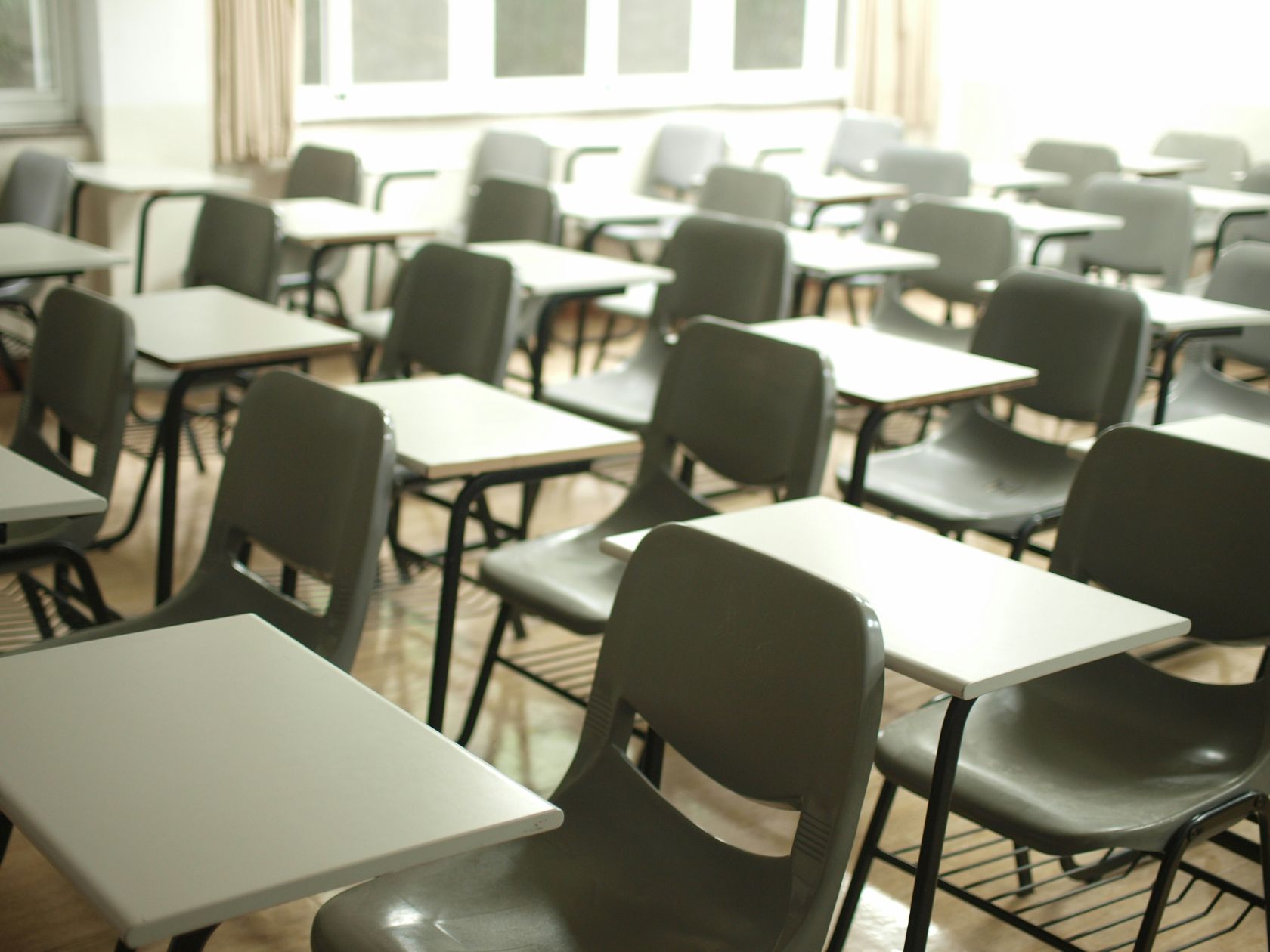
Classes temporarily without teaching activities (42.5%), allocation of recruitment groups (40%) and workload overload (38%) – at least one of these effects resulting from the lack of teachers was felt by 63.7% of the schools that responded to the questionnaire from the union structure, presented at a press conference at the EB1 School and Kindergarten of Monte Abraão, of the Ruy Belo School Group, Queluz, municipality of Sintra.
"Only 36.2% of the responses indicate that there were no problems with a lack of teachers" – this number is one of the highlights of a survey applied in the first two weeks of September, which collected responses from the principals of 29.2% of the school groups (AE) or non-grouped schools (EnA).
“The problem has worsened, and a third of principals foresee difficulties throughout the [2026/2027] school year,” the research findings note, further detailing that “59.2% of respondents say it is not possible to make any predictions,” which is “a cause for concern.”
In a press conference at a school belonging “precisely to one of the school districts most affected by the lack of teachers,” one of the general secretaries of Fenprof, Francisco Gonçalves, observed that the problem of teacher shortages has worsened in the Lisbon district, followed by the districts of Setúbal, Faro, Leiria, and Porto, being particularly felt in the 1st cycle and in subjects such as Portuguese and Mathematics.
“Special Education is also one of the most underserved recruitment groups,” he stressed.
According to data from Fenprof, last week “the estimate pointed to more than 110,000 students without all the teachers.”
Estimating that 1,102 teachers will retire in September and October, the union leader pointed the finger at the Minister of Education, saying that "problems [in schools] are not solved with daily announcements."
Regarding the problem of students without schooling, he added, "it has worsened with the dismantling of the Ministry of Education," alluding to the internal operational transformations carried out in the meantime.
According to data collected by Fenprof, the municipality of Sintra alone has 744 students without schooling, and Lisbon has 550, Francisco Gonçalves listed.
In addition to the lack of teachers, schools point to problems with technological equipment, building conditions, and school transport.
On the topic of digital transition, 65.8% of schools consider computer equipment "insufficient and obsolete," and 28.3% say "they are not even operational."
Fenprof also considers educational establishments' response to climatic conditions "one of the most worrying conclusions," revealing a "structural problem."
Schools are “poorly prepared for extreme temperatures”: 40% of responses cite cold weather, 27% heat, and 22% precipitation.
Regarding transportation and commuting, 32% of respondents identify “problems with the adequacy of the network or schedules.”
The research results – Fenprof highlights – demonstrate that “the difficulties in the functioning of schools are not limited to the lack of teachers” and that “structural problems related to human resources, equipment, buildings, thermal conditions, transportation, and student support persist, affecting the quality of educational services.”
Given this scenario, the Government “can count on Fenprof and the teachers” if it wants to “really solve the problem of the lack of teachers.” Otherwise, the union structure will continue on a path of “opposition and struggle,” notably on 5 October, World Teachers' Day, with street demonstrations.
 Add as a preferred source on Google





 Portugal Handbook
 English
 Nederlands
 Deutsch
 Français
 Español
 Italiano
 Svenska
 Pусский
 中文
中文 Türkçe
 Português
 Czech
Czech Hungarian
 Polski
 عربي
عربي Suomi
Suomi עִברִית
 Português (Brasil)
Follow us on social media