


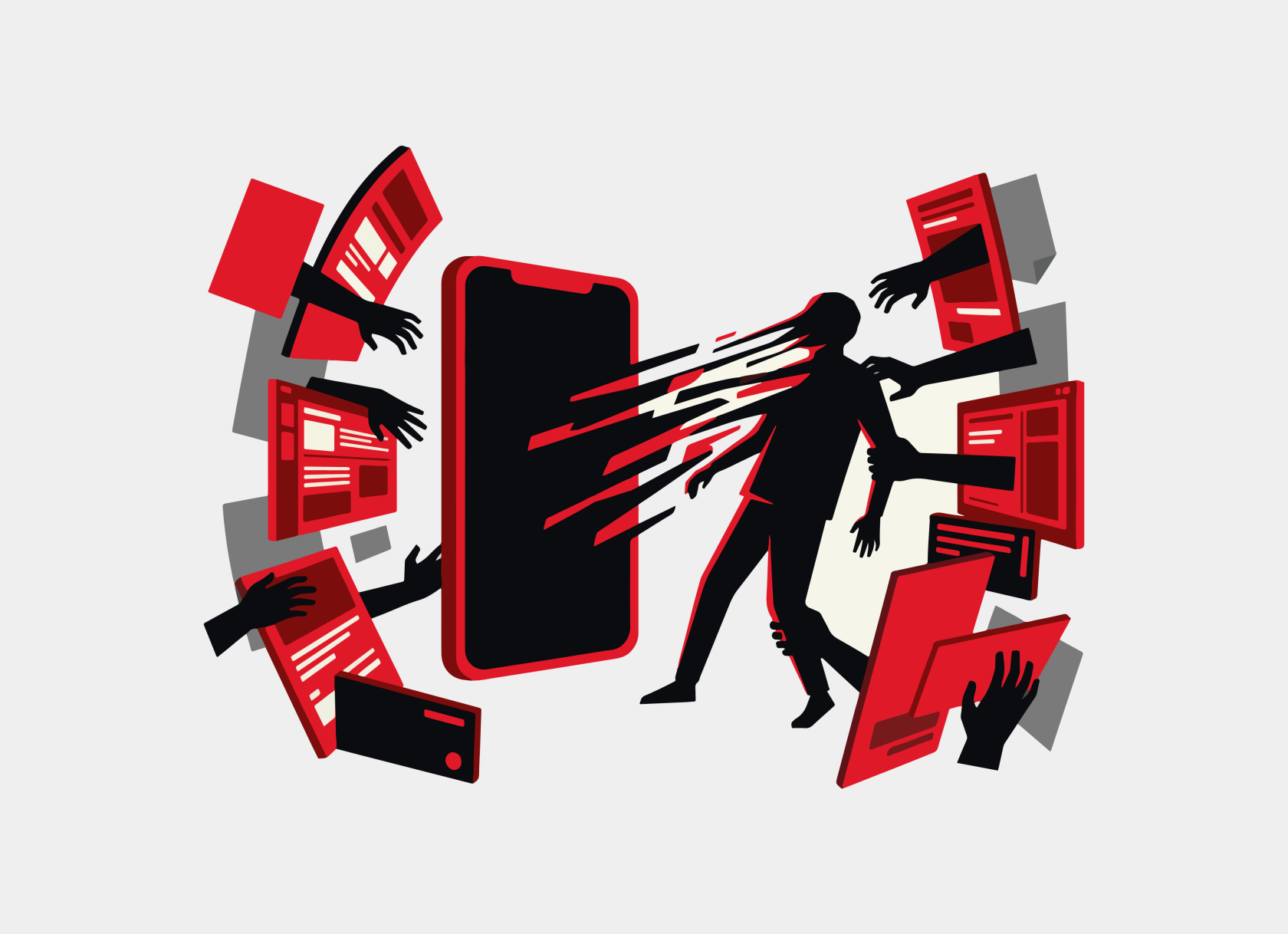
But try going a day without checking your phone, without coffee, or without that routine activity. Humans are always addicted to something.
You check your phone before you’ve even opened your eyes. You reach for a second coffee because it feels good. You keep scrolling long after anything on the screen has stopped being interesting. If any of that sounds familiar, you are not undisciplined, and you are certainly not alone. A large review pooling data from 94 studies across 40 countries found that, across every kind of behavioural addiction combined, around one in nine people showed clear clinical signs of it, a figure that climbed to nearly one in three when looking at smartphone use alone. Although not all behaviours like this are pathological, most sit somewhere on a spectrum between habit and compulsion, and the sheer scale of the numbers suggests addiction is not a rare affliction confined to a troubled few. It is closer to a default setting of modern life. What changes from person to person is not whether the pull exists, but how far it goes and what it eventually costs: a second coffee for one person, a marriage, a career or a body for another. So how far can the human mind be pushed to want, and how much of that distance was ever really a choice?
The reward system we inherited
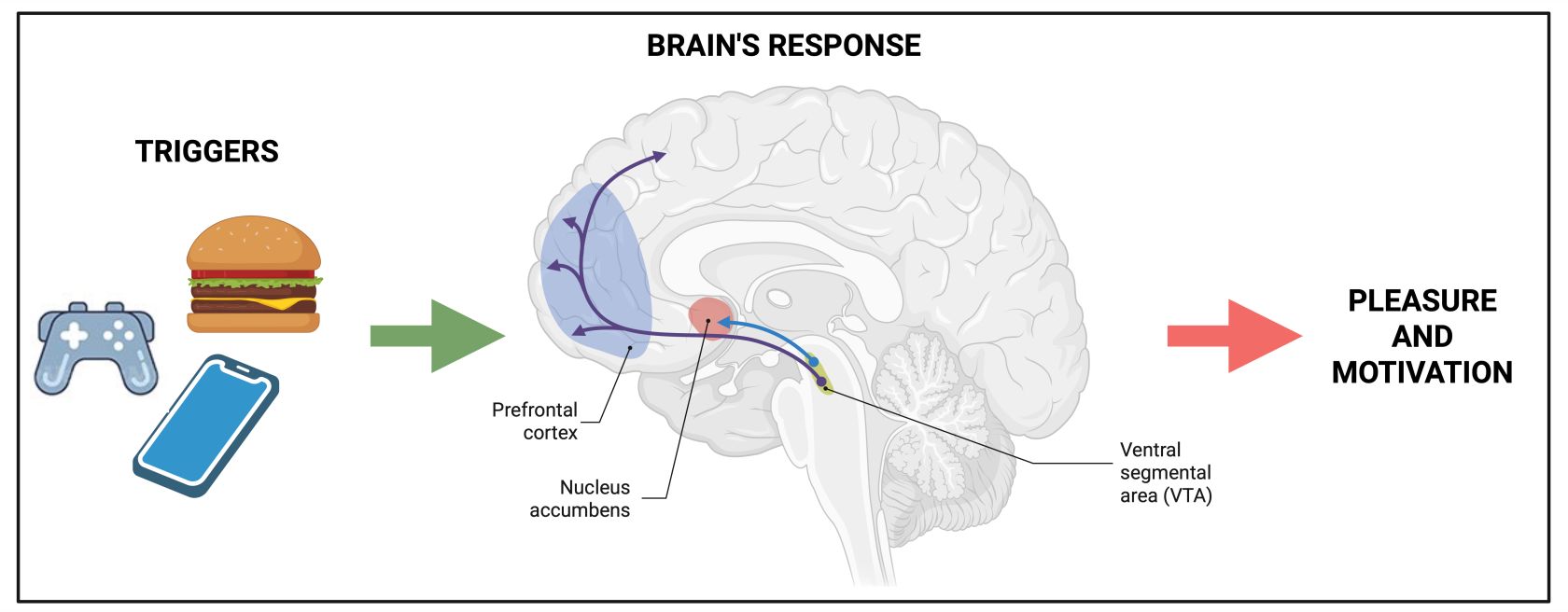
At the centre of this story is a small, ancient part of the brain called the ventral tegmental area, a cluster of cells that acts like a scout, constantly checking whether what’s happening is better than expected. Whenever it decides the answer is yes, it sends a signal to another region, the nucleus accumbens, which floods the brain with dopamine, the chemical behind motivation and craving, and makes sure you go looking for that same thing again.
For most of human history, “better than expected” meant food after a long search, a safe place to sleep, or acceptance into a group. Dopamine did not evolve to make us happy. It evolved to make us pay attention and go after what we needed again. Neuroscientists now describe this as a split between wanting and liking: the drive to pursue a reward is handled by different circuitry than the pleasure of actually receiving it. That distinction matters enormously, because it explains one of addiction’s cruellest features. A person can go on wanting something with tremendous force long after it has stopped bringing any real liking at all. The chase outlives the reward, and the numbers above are, in a sense, a record of how many chases never end.
An ancient brain in a modern world
It is theorised that this reward system evolved inside conditions of scarcity, where calories were hard to find, novelty was rare, and stimulation had natural limits. Over the past century, and especially the last two decades, entire industries have built products whose only job is to trigger this ancient circuitry as often and as intensely as possible. Ultra-processed food hits combinations of fat, sugar and salt that occur nowhere in nature. Social media feeds run on unpredictable, variable rewards, the same principle that makes slot machines so hard to walk away from; it is also the logic behind scratch cards and online betting, which more than 30,000 people in Portugal now play to a degree health authorities classify as pathological. Pornography offers a limitless stream of novelty, exploiting a preference that once nudged genetic diversity in the wild. Status itself, measured out in likes and followers, has become its own reinforcing loop. Even music can be engineered into algorithmically optimised loops built to be replayed compulsively. None of this is accidental. It is the result of enormous effort, and enormous money, spent discovering exactly what the brain cannot easily refuse.
Not everyone falls the same way, but everyone can fall
It would be dishonest to say addiction affects everyone equally. Genetics shape how sensitive a person’s reward circuitry is. Early life stress, trauma and unstable environments prime the brain toward compulsive coping later on, and poverty and isolation raise vulnerability further, which is why scratch-card addiction in Portugal, for instance, is markedly more common among people on the lowest incomes. However, we must keep in mind that the same systems that exploit dopamine sensitivity in a genetically predisposed person are, by design, aimed at everyone else too. A well-adjusted adult with no family history of addiction can still find themselves reaching for their phone forty times a day without ever deciding to. The industries behind these products did not build them for the vulnerable alone. They built them for all of us.
When wanting overrides everything else
The furthest edge of this story is where addiction stops looking like a bad habit and starts looking like a hijacking. As reward circuitry sensitises and stress systems stay chronically activated, a state researchers call hyperkatifeia sets in: a heightened, persistent negative mood that makes ordinary life feel flat and withdrawal feel unbearable. At that point, behaviour is driven less by the pursuit of pleasure than by the desperate avoidance of pain. This is the mechanism behind the more extreme cases: the person who steals from their own family, the parent who neglects a child, the professional who risks a career, all to feed something they may no longer even enjoy. It is tempting to read these as moral failures. The neuroscience suggests something closer to a system doing exactly what it was built to do, in an environment that never should have been able to push it this far.
Can it be cured?
The most hopeful part of this story is that the brain is not static. Imaging studies of people in recovery show real, measurable structural repair. Dopamine transporter levels that collapse during heavy substance use can climb back toward normal after a year or more of abstinence. Prefrontal control, the part of the brain responsible for saying “not now,” can be rebuilt with the right support. Portugal itself offers one of the clearest real-world examples of what taking this science seriously can achieve. When the country decriminalised personal drug use in 2001 and shifted resources from punishment toward treatment, overdose deaths and disease transmission fell sharply. It was not treated as a matter of willpower. It was treated as a medical and social problem, because that is what the evidence said it was.
Addiction exists in degrees, and not every craving deserves the same concern. But the trend line is hard to ignore: every generation seems to produce more people who fall into some form of chronic addiction. In the 1970s/80s, it was heroin and other hard drugs. Today, for a much larger share of the population, it is the phone in their pocket. The substance diversified, but the system behind it is the same. It still takes advantage of our ancient circuitry, only now by industries with increasingly more data, money, and precision. So the real question may not be how much damage any one person’s addiction does, but how much longer we can keep treating each new wave as an individual failing before we look, seriously, at the system producing wave after wave after wave.
 Add as a preferred source on Google







 Portugal Handbook
 English
 Nederlands
 Deutsch
 Français
 Español
 Italiano
 Svenska
 Pусский
 中文
中文 Türkçe
 Português
 Czech
Czech Hungarian
 Polski
 عربي
عربي Suomi
Suomi עִברִית
 Português (Brasil)
Follow us on social media