



Most healthy-eating advice arrives as a list of things to give up. Less butter, less bread, less treats, and a small app to log every regret. This week's good news runs the other way. It's about what goes onto the plate, not what comes off it.
The diet that didn't count
Anyone who has counted calories knows the evening maths. A yoghurt here, a biscuit there, and the slow discovery that a "handful" of nuts is apparently ten. The old adage "what you measure, you improve" may well be true, but let's face it, it can be exhausting and not much fun!
Researchers at the University of North Carolina wondered whether there was a friendlier route. In a two-year trial published in JAMA Network Open, they randomly assigned 360 adults living with obesity, average age 55, to one of two programmes. One was WeightWatchers, built mainly around cutting calories. The other, called "Med-South", was a Mediterranean-style plan adapted for American Southern kitchens. It spent its first four months on what to eat - more nuts, vegetable oils, whole grains, vegetables and fruit - before turning to losing weight and keeping it off.
After two years, it was a draw on the scales: 3.4 per cent of body weight lost on the Mediterranean plan, 3.5 per cent with calorie-counting. Blood pressure improved by a similar amount too. But the Mediterranean group finished with measurably better diets, and more than nine in ten of those asked said they'd recommend the programme to others.
Now the honest part. This is not a story about olive oil melting kilos. On weight alone, neither approach won. About a third of the Mediterranean group didn't come back for the final weigh-in, which muddies the picture. The plan was also led by dietitians and did get round to weight loss eventually, so it wasn't a free-for-all. What the trial suggests is narrower, and kinder: you can arrive at the same place by adding good food rather than policing every mouthful.
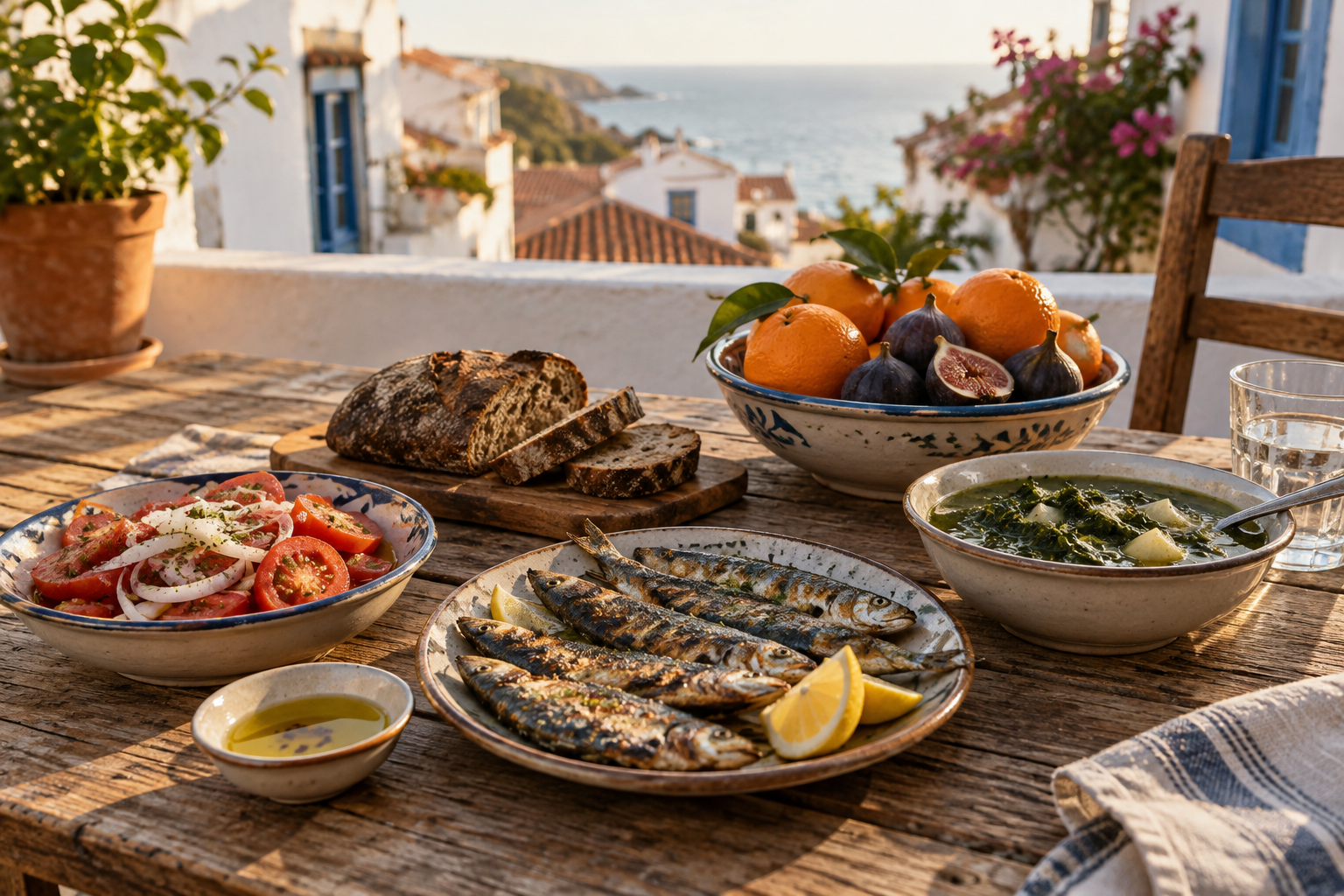
I find that rather freeing. And it's especially good news if you live here. The researchers had to translate the Mediterranean diet for North Carolina, but Portugal never needed the translation. Think grilled sardines, a drizzle of olive oil over almost everything, a bowl of caldo verde soup, and fruit for pudding.
Two roads diverged, and I - I took the one with better food along the way.
The bread basket's comeback
Somewhere in the last twenty years, bread became the villain of the lunch table. The basket arrives, and we push it away with the air of someone resisting a great temptation.
A review published on 16 September in the European Heart Journal gives the good loaf a fair hearing. Researchers led from Tabriz University of Medical Sciences in Iran pooled 87 randomised trials involving 6,529 people. Eating more whole grains lowered weight and waist size, blood pressure, total and "bad" LDL cholesterol, triglycerides, blood sugar and a marker of inflammation.
Benefits began at around 30 to 40 grams a day. The biggest effects generally appeared at 60 to 100 grams, roughly four to six servings - porridge at breakfast, a wholegrain sandwich at lunch, a portion of brown rice at dinner. Oats, brown rice and rye each helped different measures, so variety seems to pay.
The small print matters. The trials lasted about eight weeks on average. They measured risk factors, not heart attacks or strokes, and many of the improvements were modest. The researchers' own take is that whole grains seem to work through several small nudges at once rather than one dramatic effect. Less headline-friendly, perhaps, but arguably more useful: no single miracle, just a steady, cheap, everyday helping hand.
One practical tip: a brown-looking loaf isn't always wholegrain. On Portuguese labels, look for "integral" (wholegrain) near the top of the ingredients list, or pick up a proper rye loaf. Anyone with coeliac disease, or who has been given specific advice about fibre, should stick with their own doctor's guidance.
For years we've been told which numbers to keep low: cholesterol, blood pressure, the reading on the scales. Finally, a number we want to go up.
Neither study promises a new body by Christmas. But together they make a gentler case: eating well may be less about subtraction than about generous, ordinary good food - the kind this country already does beautifully. So go on - have the bread. The wholegrain one.

OCTOBER SPOTLIGHT · BREAST CANCER AWARENESS MONTH
Ladies, one for the diary
Some of us put off mammograms partly from a quiet worry about overdiagnosis - having something found and treated that would never have caused harm. A study published in September in the Journal of the National Cancer Institute suggests that worry may have been overstated. Re-examining eight major screening trials, researchers put overdiagnosis below 5 per cent, far lower than earlier estimates of 30 to 50 per cent. It is one analysis, and false alarms still happen. But if you are due a mammogram, this is a good month to book it. Portugal's free screening programme now reaches women aged 45 to 74 in many areas - ask your GP or health centre.
Set The Portugal News as your preferred source for news on Google
 Add as a preferred source on Google








 Portugal Handbook
 English
 Nederlands
 Deutsch
 Français
 Español
 Italiano
 Svenska
 Pусский
 中文
中文 Türkçe
 Português
 Czech
Czech Hungarian
 Polski
 عربي
عربي Suomi
Suomi עִברִית
 Português (Brasil)
Follow us on social media