



Health advice has a volume problem. It likes ten thousand steps, punishing regimes and expects us to look pleased about it. By lunchtime, most of us are already behind. This week's good news is quieter.
The breathing exercise with a punchline
"Nobody should swap an inhaler or pulmonary rehabilitation for a punchline."
There is a point in a proper laugh when breathing loses all dignity. Shoulders jump, eyes water and somebody waves a hand because speech has temporarily left the building - unless breathing is already something you have to think about.
Chronic obstructive pulmonary disease, or COPD, makes life smaller. Stairs become a negotiation and conversation feels expensive when every sentence is paid for in breath.
Laughter, then, sounds an unlikely therapy. Yet a small trial presented at this year's European Respiratory Society Congress in Barcelona suggests deliberate laughter exercises may ease breathlessness about as well as established pursed-lip breathing.
Dr Goncagul Aldan, a nurse and lecturer at Hacettepe University, presented results from 63 patients at Ankara Bilkent City Hospital in Türkiye. They were randomly assigned to pursed-lip breathing; laughter exercises involving clapping, motorcycle sounds, a lion's roar and meditation; or education alone.
For eight weeks, the exercise groups practised for 30 minutes three times weekly. Both reported less breathlessness and better overall health than the control group. The breathing improvement was still evident a month later.
This finding arrives wearing a party hat, but the small print matters. The study was small and presented at a conference rather than published in a journal. Nobody should swap an inhaler or pulmonary rehabilitation for a punchline.
Breathing exercises can feel like one more must-do in a day already organised around symptoms. The sessions needed no equipment and sat alongside normal treatment. If larger studies confirm the result, there are worse instructions than half an hour of clapping and the occasional licence to roar like a lion.
The watch can stop shouting
"Ten thousand is not an exam mark, and movement is not worthless because our watch didn't throw confetti."
At some point on a walk, the fitness watch turns into a PE teacher. Nine hundred more steps, it says, as though the shopping, the stairs and the search for the glasses we were already wearing never happened.
A new British Journal of Sports Medicine study offers the watch - and us - a little flexibility. Its analysis included 64,743 UK Biobank participants. Among those taking fewer than 5,000 steps a day, a brisker pace was linked with substantially lower mortality risk. The reduction resembled that seen with 5,000 to 7,500 gentler steps; the lowest overall risk appeared between 7,500 and 10,000.
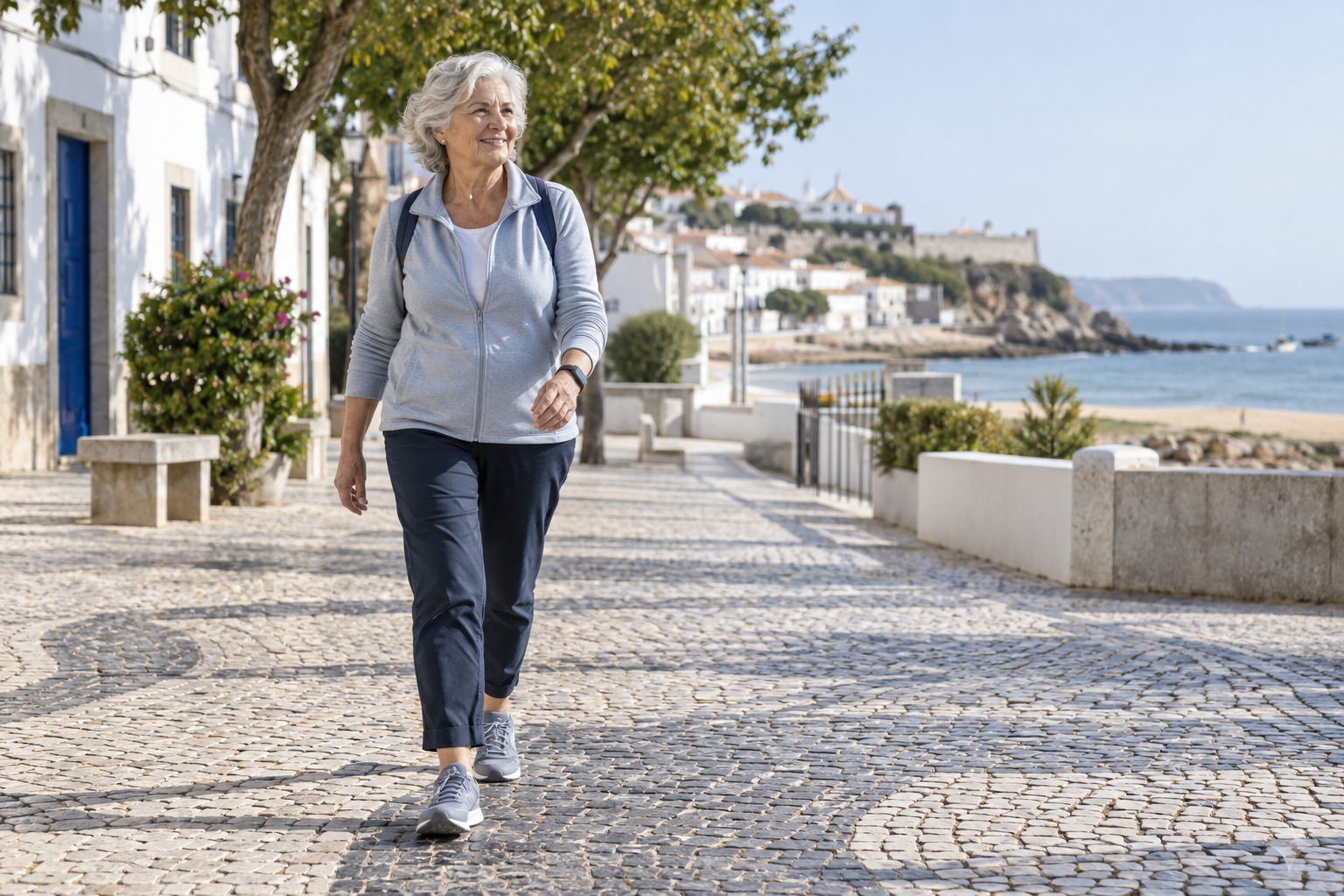
Pace came from each person's most active 30 minutes, which need not be consecutive. The paper's low-step example used about 80 steps a minute, against 60 for the gentler comparison: a nudge, not a sprint.
This was observational research, so it cannot prove that changing pace extends life; faster walkers may already be healthier. Nor should anyone with pain, poor balance or a heart condition be bullied by a wristwatch - particularly on Portuguese calçada, which can turn brisk walking into advanced footwork.
The helpful message is choice. If speed is difficult, comfortable steps still count; if time is short and it is safe for you, a livelier few minutes may add something. Ten thousand is not an exam mark, and movement is not worthless because our watch didn't throw confetti.
Prepare the mind as well as the overnight bag
"Fear is not a character flaw to pack away with the dressing gown."
A hospital gown can remove your confidence before the doctor has entered the room. We prepare for surgery with tests, forms, fasting instructions and too much in the overnight bag.
A trial published this week in JAMA Network Open followed 306 adults aged 60 or over facing heart, cancer, hip or knee procedures, all with mild-to-moderate anxiety or depression. Half received self-help material. The others were offered eight to 12 telephone sessions with a mental-health coach - a social worker or counsellor - covering worries, sleep and goals, plus a pharmacist's medication review. The coaching began before surgery and continued afterwards: weeks of company, not a pep talk on the morning.
Three months later, anxiety and depression scores were modestly better in the supported group. The clearest benefit appeared among cancer patients; the heart and orthopaedic groups showed no statistically clear improvement on their own.
Cheerful thoughts do not fix surgery. But fear is not a character flaw to pack away with the dressing gown. Emotional health and medication deserve attention alongside blood pressure and blood tests. Sometimes preparation begins with: "I'm frightened. What support is available?"
Three victories in three days
On 3 September, WHO validated Timor-Leste's elimination of trachoma as a public-health problem; the infection no longer has that status anywhere in WHO's South-East Asia Region. The next day, Bhutan became the region's first country validated for eliminating dog-transmitted human rabies as a public-health problem. On the third, WHO verified Thailand for eliminating rubella as a public-health problem.
These are elimination milestones, not eradication: surveillance, vaccination and treatment must continue. But three countries, three diseases and three consecutive days are worth pausing over.
Progress is rarely one heroic leap. Sometimes it is a laugh, a slightly quicker step, an honest conversation - and then another small thing, repeated until it makes history.
 Add as a preferred source on Google







 Portugal Handbook
 English
 Nederlands
 Deutsch
 Français
 Español
 Italiano
 Svenska
 Pусский
 中文
中文 Türkçe
 Português
 Czech
Czech Hungarian
 Polski
 عربي
عربي Suomi
Suomi עִברִית
 Português (Brasil)
Follow us on social media